Introduction
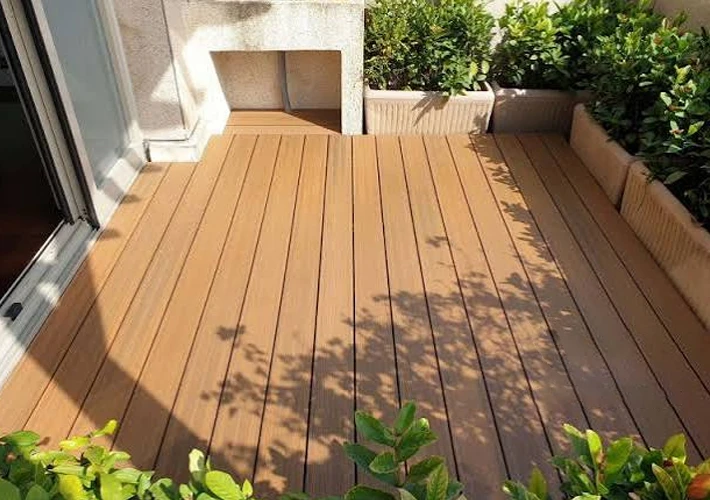
Swimming pool environments place unusually high demands on outdoor decking materials. Unlike ordinary garden terraces or residential balconies, poolside surfaces are continuously exposed to water splashes, high humidity, strong sunlight, temperature fluctuations, chlorine-containing water, and frequent foot traffic. For commercial swimming pools, hotels, resorts, water parks, and residential pool projects, choosing the right decking material is essential for long-term performance, user comfort, and maintenance costs.
Traditional timber decking offers a natural appearance, but it often requires regular sealing, staining, and maintenance. Conventional wood-plastic composite (WPC) decking provides better moisture resistance than natural wood, yet its surface performance under intense UV exposure and high outdoor temperatures can vary depending on the material formulation and manufacturing quality.
This is where ASA decking for swimming pools offers an interesting alternative.
ASA, short for Acrylonitrile Styrene Acrylate, is a high-performance thermoplastic material known for its weather resistance, UV stability, color retention, and outdoor durability. In composite decking applications, ASA is commonly used as a protective surface layer over a composite core. This combination brings together the structural advantages of composite materials and the weather-resistant properties of ASA.
For swimming pool projects, ASA composite decking can provide several practical advantages, including improved resistance to sunlight, reduced maintenance requirements, attractive wood-like finishes, and better long-term appearance.
As a professional Chinese composite decking manufacturer, Solidexwood focuses on outdoor composite solutions for international distributors, importers, contractors, and project developers. Our ASA outdoor decking range is developed for demanding exterior environments where appearance, durability, and consistent product quality matter.
This article explores the unique advantages of ASA decking around swimming pools, compares it with other poolside materials, and explains what wholesale buyers and project contractors should consider before placing bulk orders.
What Is ASA Decking and Why Is It Suitable for Swimming Pools?
Before comparing different poolside materials, it is important to understand the structure and performance characteristics of ASA decking.
Understanding ASA Material
ASA stands for Acrylonitrile Styrene Acrylate, an engineering thermoplastic developed to provide good resistance to outdoor environmental conditions.
Its three main components contribute different characteristics:
- Acrylonitrile: Helps provide chemical resistance, mechanical strength, and dimensional stability.
- Styrene: Contributes to processing performance, rigidity, and surface quality.
- Acrylate rubber: Improves weatherability and resistance to outdoor aging, particularly under UV exposure.
One of the main reasons ASA is widely used in outdoor applications is its ability to maintain appearance under prolonged sunlight exposure.
Unlike some conventional plastics that can become discolored, brittle, or degraded after extended exposure to UV radiation, properly formulated ASA materials offer better resistance to weather-related surface deterioration.
For outdoor construction materials, this characteristic is especially valuable in regions with intense sunlight, high temperatures, and long summer seasons.
How ASA Composite Decking Is Manufactured
ASA decking generally combines a composite substrate with a protective ASA surface layer.
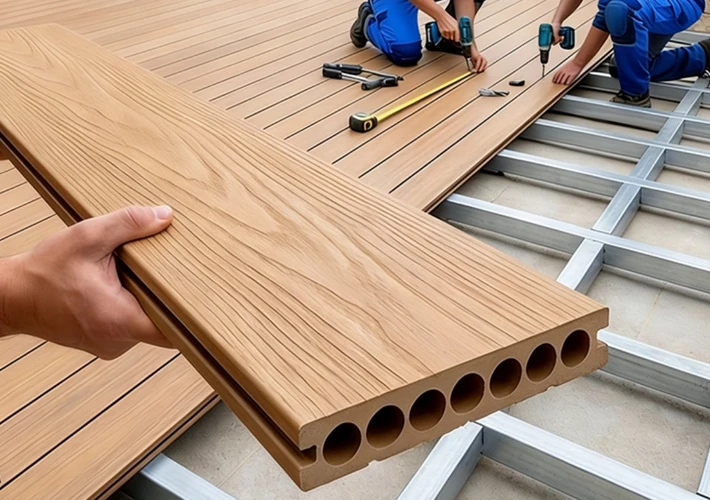
The composite core may contain wood fibers, plastic polymers, and other formulation additives. The ASA layer is applied through a co-extrusion process, forming a protective outer surface around the composite substrate.
The two layers serve different purposes:
| Component | Main Function |
|---|---|
| Composite core | Provides structural support, stiffness, and board stability |
| ASA protective layer | Improves UV resistance, weatherability, surface durability, and color retention |
| Surface texture | Provides the desired appearance and contributes to underfoot traction |
The combination makes ASA composite decking suitable for various outdoor applications, including:
- Swimming pool surrounds
- Hotel pool terraces
- Resort outdoor relaxation areas
- Garden decks
- Outdoor restaurants
- Coastal properties
- Commercial landscape projects
- Waterfront leisure facilities
However, buyers should understand that ASA decking is not automatically waterproof in every aspect simply because it has an ASA surface. The actual moisture resistance depends on the complete board structure, core formulation, joints, installation method, and drainage design.
Why Poolside Projects Need Specialized Decking
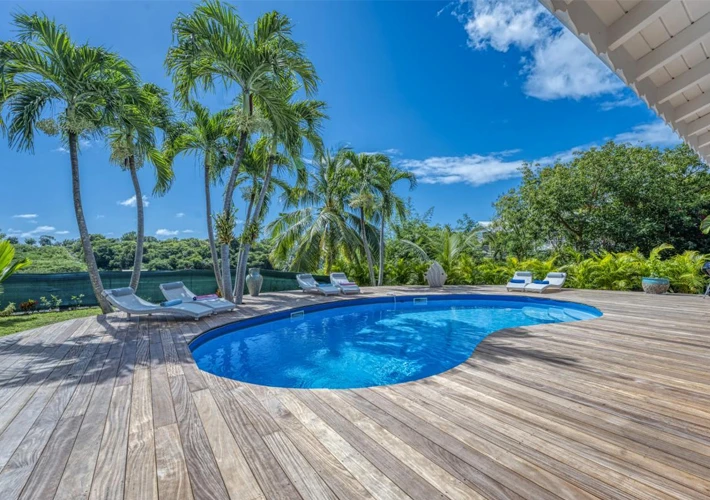
A swimming pool deck is exposed to conditions that are different from those found in ordinary outdoor spaces.
First, water is constantly introduced onto the decking surface by swimmers, cleaning activities, and rainfall. Second, poolside surfaces receive considerable direct sunlight, especially in tropical and subtropical climates. Third, chlorine-containing water and cleaning chemicals may contact the surface regularly.
These conditions can accelerate the aging of unsuitable decking materials.
ASA composite decking addresses several of these challenges through its protective surface technology and composite construction.
For importers and contractors purchasing materials for swimming pool projects, this combination can offer a practical balance between visual appeal, outdoor durability, and maintenance efficiency.
Seven Unique Advantages of ASA Decking for Swimming Pools
The suitability of ASA decking for swimming pools comes from the combination of its protective surface layer and composite structure. For buyers evaluating materials for hotels, resorts, residential swimming pools, and commercial leisure facilities, the following advantages deserve particular attention.
1. Excellent UV Resistance and Long-Term Color Retention
One of the biggest challenges for poolside decking is prolonged exposure to ultraviolet radiation.
Swimming pools are often installed in open outdoor areas with little or no shade. During summer, decking boards may receive direct sunlight for several hours every day. Over time, UV radiation can damage the surface of conventional outdoor materials, resulting in fading, discoloration, surface deterioration, and changes in appearance.
This is particularly problematic for commercial swimming pool projects. A hotel or resort needs to maintain a consistent and attractive outdoor environment because the pool area is often one of the most photographed parts of the property.
ASA material offers excellent UV resistance compared with many conventional outdoor plastics. Its chemical structure helps the surface retain its appearance under prolonged sunlight exposure.
For poolside applications, this provides several benefits:
- Better resistance to sunlight-related discoloration.
- Improved long-term appearance in outdoor environments.
- Reduced need for frequent surface refinishing.
- More consistent colors across large decking installations.
- Better suitability for tropical and high-UV climates.
For importers and distributors supplying markets such as Australia, Southeast Asia, the Middle East, and Southern Europe, UV resistance is an important product-selling point.
However, actual color stability depends on the ASA formulation, pigment selection, production process, and exposure conditions. Buyers should request UV-aging test reports rather than relying exclusively on general material descriptions.
2. Better Surface Weatherability in Outdoor Pool Environments
Poolside decking experiences more than sunlight. It must also withstand rain, humidity, temperature fluctuations, and repeated wetting and drying cycles.
Natural wood can absorb moisture, swell, shrink, and develop cracks if it is not properly maintained. Some conventional plastic decking products may experience surface aging or changes in appearance after long-term exposure to outdoor conditions.
ASA composite decking combines a weather-resistant surface layer with a composite core to improve its suitability for exterior environments.
Its main weather-related advantages include:
Resistance to outdoor aging
The ASA surface helps protect the decking from UV-related deterioration and contributes to long-term outdoor performance.
Reduced dependence on protective coatings
Unlike natural timber, ASA composite decking generally does not require regular painting, staining, or oiling to maintain its protective surface.
Improved suitability for humid environments
The composite structure can offer better moisture resistance than untreated natural wood, while the ASA layer provides an additional protective surface.
More stable appearance across seasons
For projects exposed to changing weather conditions, a properly manufactured ASA decking board can help maintain a more consistent appearance.
It is important to distinguish between surface weatherability and complete waterproofing. Water can still enter through exposed board ends, damaged areas, joints, or improperly designed installation systems. Proper drainage, ventilation, and installation details remain essential.
3. A More Comfortable Poolside Experience with Better Thermal Performance
Surface temperature is an important consideration when choosing decking for swimming pools.
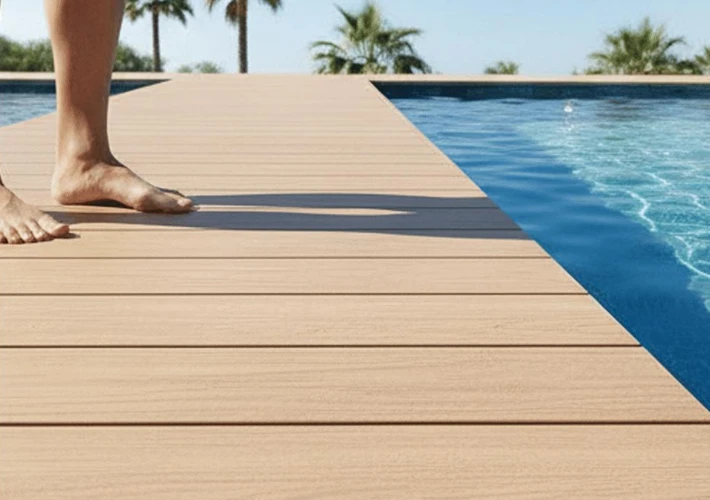
During hot summer days, traditional concrete, stone, and some dark-colored outdoor surfaces can become extremely hot under direct sunlight. This can make walking barefoot uncomfortable, especially around children’s pools, hotel swimming areas, and resort relaxation zones.
For this reason, thermal comfort is an increasingly important consideration in outdoor decking selection.
Solidexwood’s ASA outdoor decking range is positioned with a focus on improved outdoor comfort and reduced heat buildup compared with conventional PE decking alternatives.
Depending on the formulation, board color, surface structure, installation conditions, and exposure, this can help create a more comfortable poolside environment.
Several factors influence decking surface temperature:
- Material composition: Different polymers and composite formulations absorb and release heat differently.
- Board color: Darker surfaces generally absorb more solar radiation than lighter colors.
- Surface design: Texture, reflectivity, and finish can influence heat absorption.
- Ventilation: Air circulation underneath the decking can affect heat dissipation.
- Sun exposure: A fully exposed pool deck will usually experience higher surface temperatures than a shaded terrace.
For swimming pool projects, the objective is not simply to select a durable board but to create a comfortable environment for people walking barefoot between the pool, lounge chairs, showers, and outdoor entertainment areas.
Why is this important for B2B buyers?
Hotels, resorts, and swimming pool contractors increasingly need materials that combine durability with user comfort. A decking product that addresses both requirements can provide a stronger value proposition when presenting proposals to project owners.
Nevertheless, no composite decking should be advertised as completely cool under direct sunlight without supporting comparative test data. Buyers should request surface-temperature comparisons under equivalent test conditions, particularly when supplying hot-climate markets.
4. Improved Resistance to Moisture and Poolside Water Exposure
Water is unavoidable around swimming pools. The decking surface is regularly exposed to splashing, wet feet, rainwater, and cleaning activities.
For traditional timber, repeated exposure to moisture can create several problems:
- Swelling and dimensional changes.
- Surface cracking and splintering.
- Mold and mildew development under unfavorable conditions.
- Increased maintenance requirements.
- Shortened service life when drainage is poor.
ASA composite decking offers a more practical alternative for many outdoor poolside projects.
The composite core generally absorbs less moisture than untreated timber, while the ASA outer layer provides additional surface protection.
This combination makes ASA decking suitable for areas where regular water exposure is expected.
Typical applications include:
Residential swimming pools
Homeowners and developers can use ASA decking to create a continuous outdoor surface around swimming pools, connecting the pool with gardens, patios, and outdoor seating areas.
Hotel swimming pools
Hotel pool decks require materials that can withstand frequent use, regular cleaning, and repeated exposure to water. ASA composite decking can reduce the maintenance burden associated with natural wood.
Resort and waterfront facilities
Resorts often combine swimming pools, outdoor restaurants, sunbathing platforms, and landscaped leisure spaces. Weather-resistant composite decking can help create a consistent exterior design.
Commercial water recreation facilities
For water parks and public swimming facilities, material selection should consider not only moisture resistance but also slip resistance, structural loading, cleaning chemicals, and local safety requirements.
An important purchasing consideration is that water resistance does not automatically mean suitability for permanent underwater use. ASA decking is designed for exterior decking applications, not as a substitute for submerged structural materials or pool waterproofing systems.
5. Low Maintenance and Reduced Long-Term Operating Costs
Maintenance costs are an important part of the total cost of ownership for commercial swimming pool projects.
Natural timber may look attractive when newly installed, but its appearance can deteriorate without proper care. Depending on the timber species and environmental conditions, regular cleaning, sealing, staining, sanding, and board replacement may be necessary.
For hotels and resorts, these activities create additional operating expenses and may require temporarily restricting access to poolside areas.
ASA composite decking can help simplify maintenance.
In normal outdoor applications, routine cleaning is generally sufficient to maintain the surface.
Typical maintenance activities include:
- Sweeping away leaves, dust, and loose debris.
- Washing the decking with water and a suitable mild detergent.
- Removing stains using cleaning products approved by the manufacturer.
- Checking gaps and drainage channels for accumulated debris.
- Inspecting fasteners, joists, and structural supports periodically.
ASA composite decking generally does not require the same regular staining and sealing associated with natural timber.
For commercial buyers, this offers several potential advantages:
- Lower routine maintenance requirements.
- Reduced demand for protective coating products.
- Less frequent surface refinishing.
- More predictable maintenance planning.
- Reduced disruption to hotel and resort operations.
The initial purchase price is only one part of the overall project cost. A more meaningful comparison should consider installation, maintenance, replacement, cleaning, and expected service life.
For wholesalers and project contractors, explaining the total cost of ownership can help customers understand why a higher-performance composite decking solution may offer better long-term value than a cheaper alternative.
6. Wood-Like Appearance with More Flexible Design Options
Swimming pool decking is both a functional building material and an important landscape design element.
The right decking color and surface texture can influence the entire appearance of an outdoor swimming area.
Natural timber offers an attractive appearance, but it may require more maintenance to preserve its original color. Concrete and stone can create a contemporary aesthetic, but they may not provide the warm, natural appearance that many hotel and residential projects want.
ASA composite decking can combine the visual appeal of wood with the practical characteristics of modern composite materials.
Common color and finish options include:
| Color / Finish | Recommended Application |
|---|---|
| Teak | Tropical resorts and natural-style pool landscapes |
| Walnut | Luxury hotels and premium outdoor terraces |
| Light oak | Modern residential swimming pools |
| Grey | Contemporary commercial and minimalist projects |
| Dark brown | Traditional outdoor leisure spaces |
| Wood grain texture | Projects seeking a natural timber appearance |
Color consistency is particularly important for large commercial projects.
A hotel may install decking around several swimming pools, outdoor restaurants, balconies, and relaxation zones. Using consistent materials and colors can help create a unified architectural identity.
For importers and distributors, offering several colors and surface textures can also help address different regional market preferences.
Solidexwood works with international B2B buyers seeking composite outdoor products for different project requirements. Depending on product specifications and order quantities, customized colors, dimensions, surface designs, and packaging can be discussed with the factory.
7. Durable Surface Protection for High-Traffic Outdoor Areas
Swimming pool decking is frequently exposed to foot traffic.
In residential settings, family members and guests regularly walk between the pool and surrounding outdoor areas. In commercial facilities, the traffic volume can be much higher, especially during holidays, weekends, and peak tourism seasons.
A suitable poolside decking product should maintain its surface quality under repeated use.
The ASA protective layer contributes to surface durability and helps resist common outdoor wear. It can also help protect the composite core from direct environmental exposure.
For project buyers, the relevant performance considerations include:
- Surface abrasion resistance.
- Scratch resistance.
- Resistance to common household and commercial cleaning products.
- Resistance to UV-related surface deterioration.
- Color stability.
- Dimensional stability under temperature changes.
It is important to note that ASA decking is not scratch-proof or damage-proof. Heavy furniture, sharp objects, dragged equipment, and improper cleaning methods may still damage the surface.
For commercial pool projects, buyers should request product-specific abrasion, impact, and weather-aging test results.
A well-designed ASA decking system, combined with correct installation and suitable maintenance, can provide a practical solution for outdoor areas with frequent pedestrian traffic.
Is ASA Decking Better Than Traditional WPC, Natural Wood, and PVC for Swimming Pools?
When selecting poolside materials, project owners often compare ASA composite decking with natural timber, conventional WPC decking, and PVC decking.
Each material has different advantages, costs, and application limitations.
The best choice depends on project location, budget, design requirements, expected foot traffic, maintenance capacity, and technical specifications.
ASA Decking vs. Traditional WPC Decking
Traditional WPC decking is widely used for outdoor terraces, gardens, balconies, and swimming pool surrounds.
It combines wood fibers and plastic polymers to create a composite material that offers an alternative to natural timber.
ASA decking builds on the composite concept by incorporating an additional ASA protective surface.
The main difference is the surface technology.
| Comparison Factor | ASA Composite Decking | Traditional WPC Decking |
|---|---|---|
| UV resistance | Generally higher with a suitable ASA formulation | Depends on formulation and additives |
| Color retention | Designed for improved outdoor color stability | Varies by product quality |
| Surface protection | ASA protective layer | Depends on board construction |
| Moisture resistance | Depends on the complete composite structure | Depends on core formulation |
| Maintenance | Generally low | Generally low |
| Design options | Multiple colors and textures | Multiple colors and textures |
| Initial price | Often higher | Often more economical |
| Outdoor application | Suitable for demanding exterior environments | Suitable for many outdoor applications |
For buyers supplying markets with strong sunlight, ASA decking can offer a competitive advantage because of its weather-resistant surface.
However, traditional WPC should not be treated as an inferior product in every application. High-quality conventional WPC can perform well in many outdoor environments.
The purchasing decision should be based on actual product specifications and test results.
ASA Decking vs. Natural Wood Decking
Natural wood remains popular because of its authentic texture and natural appearance.
However, its performance around swimming pools depends heavily on the wood species, treatment process, installation, and maintenance.
| Comparison Factor | ASA Composite Decking | Natural Wood Decking |
|---|---|---|
| Appearance | Wood-like surface options | Authentic natural grain |
| Moisture resistance | Generally better than untreated timber | Varies by species and treatment |
| UV resistance | Good with suitable ASA formulation | May fade or weather |
| Maintenance | Generally low | Often requires regular treatment |
| Splintering | Not subject to timber splintering in the same way | Possible as wood ages |
| Color consistency | More controllable through production | Natural variation |
| Installation | Requires composite-specific installation | Depends on timber system |
| Long-term upkeep | Generally lower | Can be higher |
For commercial swimming pools, the lower maintenance requirements of composite decking can be attractive.
Natural wood may still be preferred for high-end projects where authentic timber is a priority and the owner has the budget and maintenance resources to preserve it.
ASA Decking vs. PVC Decking
PVC decking is another alternative for outdoor environments.
It is made primarily from polyvinyl chloride and can offer strong moisture resistance.
ASA composite decking differs in that it typically combines a composite core with an ASA protective outer layer.
| Comparison Factor | ASA Composite Decking | PVC Decking |
|---|---|---|
| Core structure | Wood-plastic composite or other composite formulation | PVC-based structure |
| Surface protection | ASA cap layer | PVC surface |
| Moisture performance | Depends on core and board design | Generally very low water absorption |
| UV performance | Good with suitable ASA formulation | Depends on PVC formulation and UV additives |
| Appearance | Wood-like composite appearance | Various molded finishes |
| Thermal performance | Depends on color and construction | Depends on formulation and color |
| Maintenance | Low | Low |
| Environmental considerations | Depends on recycled content and material formulation | Depends on material sourcing and recyclability |
There is no universal winner across all performance categories.
ASA composite decking may be more attractive to buyers seeking a wood-like composite appearance combined with a weather-resistant protective layer. PVC decking may be more suitable for projects that prioritize a predominantly plastic structure and very low water absorption.
For importers, the most useful approach is to compare complete product specifications rather than making purchasing decisions based only on material names.
Important Performance Requirements for ASA Decking Around Swimming Pools
Although ASA composite decking offers several advantages, not every ASA decking product is automatically suitable for every swimming pool project.
For importers, wholesalers, architects, and contractors, evaluating technical performance is essential before purchasing materials in bulk.
The following factors should be included in product selection and quality inspection.
Slip Resistance: A Critical Poolside Safety Requirement
Slip resistance is one of the most important considerations for swimming pool decking.
Unlike ordinary outdoor terraces, poolside areas are frequently wet. People may walk barefoot from the swimming pool to showers, lounge chairs, changing rooms, and restaurants.
A slippery surface can increase the risk of accidents.
When purchasing ASA decking for swimming pools, buyers should pay attention to:
- Surface texture and profile design.
- Wet-condition slip resistance.
- Water drainage performance.
- Board spacing and installation gaps.
- Applicable local safety standards.
Grooved and textured decking surfaces are commonly selected for outdoor environments because they provide a different contact surface from smooth boards.
However, grooves alone do not guarantee slip resistance. The actual performance must be evaluated through an appropriate wet-condition test.
For public swimming pools, hotels, and commercial leisure facilities, buyers should request relevant test reports and confirm that the selected product meets the applicable local requirements.
Drainage and Water Management
Good drainage is essential for every swimming pool decking installation.
Even when a decking board has excellent moisture resistance, standing water can create operational problems.
Poor drainage may contribute to:
- Algae and dirt accumulation.
- Slippery surface conditions.
- Increased cleaning requirements.
- Moisture accumulation underneath the decking.
- Deterioration of supporting structures.
A properly designed ASA decking installation should allow water to drain efficiently.
The installation system should include appropriate board spacing, sufficient slope where required, unobstructed drainage channels, and adequate ventilation underneath the decking.
For commercial swimming pool projects, contractors should consider the entire drainage system rather than evaluating only the decking board itself.
Resistance to Chlorine and Cleaning Chemicals
Swimming pools commonly use chlorine-based water treatment systems. Poolside decking may also come into contact with detergents, disinfectants, and other cleaning products.
ASA offers useful chemical resistance characteristics, but the complete decking board must be evaluated for compatibility with the chemicals used at the project site.
Buyers should ask manufacturers about resistance to:
- Chlorinated pool water.
- Common pool cleaning products.
- Mild detergents.
- Salt-containing water.
- Routine commercial cleaning agents.
Concentrated chemicals, strong acids, solvents, and prolonged exposure to aggressive cleaning agents may damage some composite surfaces.
A practical recommendation is to request a chemical compatibility statement from the manufacturer and follow its cleaning guidelines.
Dimensional Stability and Temperature Changes
Outdoor swimming pool decking is exposed to daily and seasonal temperature fluctuations.
In hot climates, board surfaces may become significantly warmer than the surrounding air. Composite materials also expand and contract as temperatures change.
Therefore, dimensional stability is an important consideration.
Before purchasing, buyers should check:
- Thermal expansion characteristics.
- Recommended installation gaps.
- Board length and thickness tolerances.
- Maximum joist spacing.
- Fixing and fastening requirements.
- Installation recommendations for high-temperature environments.
Proper expansion gaps help prevent excessive pressure between boards during hot weather.
For international projects, installation instructions should be adapted to local climate conditions rather than applying one fixed spacing specification to every market.
Structural Strength and Load-Bearing Capacity
Swimming pool decking may support people, outdoor furniture, sun loungers, tables, and maintenance equipment.
Commercial facilities may also experience concentrated loads in certain areas.
Buyers should therefore request technical information about:
- Flexural strength.
- Impact resistance.
- Board stiffness.
- Recommended support spacing.
- Maximum permitted loading.
- Fastener compatibility.
A decking board should never be selected based only on its visual thickness.
The supporting joist system, fixing method, installation substrate, and overall deck design all influence structural performance.
For projects around public swimming pools, the complete decking assembly should comply with the relevant building and safety requirements.
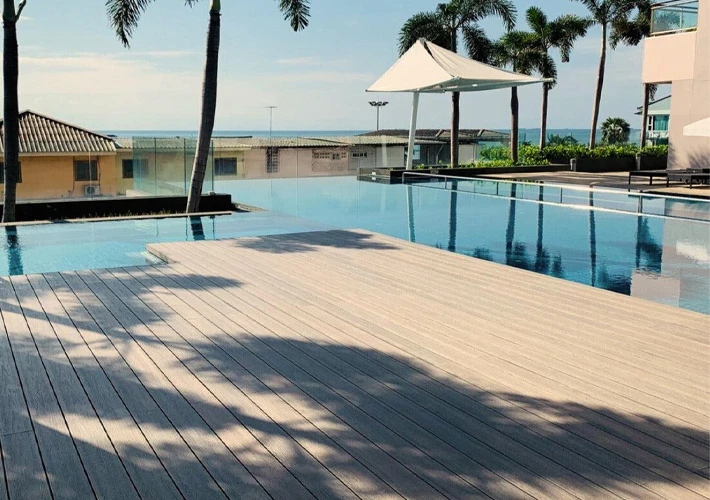
Best Applications of ASA Composite Decking in Swimming Pool Projects
ASA decking is suitable for a range of outdoor leisure environments. Its combination of weather-resistant surface protection, composite construction, and wood-like appearance makes it particularly interesting for commercial projects.
Below are some of the most common applications.
Luxury Hotel Swimming Pools
Hotel swimming pools are important facilities that influence guest satisfaction and the overall image of a property.
A premium poolside environment needs to combine attractive design, comfortable walking surfaces, and manageable maintenance requirements.
ASA composite decking can be used around:
- Outdoor swimming pools.
- Infinity pools.
- Rooftop swimming pools.
- Poolside lounge areas.
- Outdoor bars.
- Hotel garden terraces.
For hotel developers and contractors, choosing a consistent decking color can help connect the pool area with the hotel’s architectural style.
Teak and walnut finishes are often suitable for natural luxury themes, while grey and lighter wood tones can complement contemporary hotel designs.
Resort and Holiday Village Swimming Pools
Resorts frequently include multiple swimming pools, landscaped gardens, outdoor restaurants, and relaxation areas.
These facilities need materials that can maintain a consistent appearance across large outdoor spaces.
ASA decking can be used for:
- Main swimming pool surrounds.
- Family pool areas.
- Outdoor relaxation platforms.
- Poolside walkways.
- Sunbathing terraces.
- Outdoor entertainment zones.
For resorts located in tropical destinations, UV resistance and weatherability are especially important.
A consistent decking product across different outdoor facilities can also simplify procurement, maintenance planning, and replacement management.
Residential Swimming Pools
Residential swimming pools are another potential market for ASA composite decking.
Homeowners increasingly want outdoor spaces that combine swimming, relaxation, dining, and entertainment.
ASA decking can create a visual connection between the swimming pool and other exterior areas.
Typical residential applications include:
- Backyard swimming pool surrounds.
- Garden decking.
- Poolside seating platforms.
- Outdoor shower areas.
- Patio extensions.
- Private villa terraces.
For residential developers and building material distributors, offering several decking colors and surface textures can help meet different architectural preferences.
Public Swimming Pools and Sports Facilities
Public swimming pools have different requirements from residential pools.
They generally experience higher pedestrian traffic and more frequent cleaning.
When specifying ASA decking for public facilities, project teams should pay particular attention to slip resistance, structural loading, chemical compatibility, and compliance with local regulations.
Potential applications include:
- Outdoor swimming pool platforms.
- Spectator relaxation areas.
- Poolside seating zones.
- Exterior walkways.
- Supporting leisure terraces.
For heavily used public facilities, the product should be evaluated using appropriate performance testing before installation.
Coastal Hotels and Waterfront Leisure Areas
Coastal environments create additional challenges for exterior materials.
Decking may be exposed to strong sunlight, high humidity, wind-driven rain, and salt-containing air.
ASA’s weather-resistant characteristics can make it an attractive choice for coastal projects.
However, salt exposure should not be confused with guaranteed corrosion resistance of the entire decking system. Metal clips, screws, joists, and supporting structures must also be selected for the relevant coastal environment.
For coastal hotel projects, buyers should consider the complete installation system, including corrosion-resistant fasteners and appropriate drainage.
How to Choose the Right ASA Decking Manufacturer in China
For international importers and wholesalers, choosing the right factory is just as important as choosing the right decking material.
A reliable supplier should be able to provide consistent production quality, technical documentation, customized specifications, export packaging, and professional communication.
When sourcing ASA decking from China, buyers should evaluate the following factors.
Check the ASA Surface Layer Quality
The ASA surface is one of the main selling points of ASA composite decking.
However, not all products use the same material formulation or surface thickness.
Buyers should ask manufacturers about:
- ASA material specifications.
- Surface layer thickness.
- UV-resistant additives.
- Pigment quality.
- Surface adhesion.
- Weather-aging test results.
The thickness and quality of the ASA layer can influence surface protection and long-term performance.
Importers should avoid evaluating products solely by their appearance in factory photographs.
Where possible, request samples and compare surface quality under similar conditions.
Evaluate the Composite Core Formulation
The composite core is responsible for much of the board’s structural performance.
Its formulation may include wood fibers, plastic polymers, stabilizers, processing additives, and other components.
Important questions include:
- What is the core material composition?
- What is the recycled material content, if any?
- How is moisture absorption controlled?
- What dimensional tolerances are maintained?
- What quality inspections are performed during production?
A good manufacturer should be able to explain the structure and performance characteristics of its products.
Request Relevant Test Reports and Certifications
Technical documentation is particularly important when exporting ASA decking to developed markets.
Depending on the destination and project requirements, buyers may need information about:
| Test or Document | Why It Matters |
|---|---|
| UV-aging test | Evaluates resistance to accelerated weather exposure |
| Water absorption test | Helps assess moisture performance |
| Slip resistance test | Evaluates walking safety under specified conditions |
| Flexural strength test | Assesses structural performance |
| Impact resistance test | Evaluates resistance to physical impacts |
| Dimensional stability test | Examines changes under temperature conditions |
| Chemical resistance test | Evaluates compatibility with specified chemicals |
| Environmental documentation | Supports material and compliance assessments |
Not every project requires every test. The appropriate documents depend on the destination market, product specifications, and intended application.
Buyers should also verify that reports correspond to the actual product being purchased.
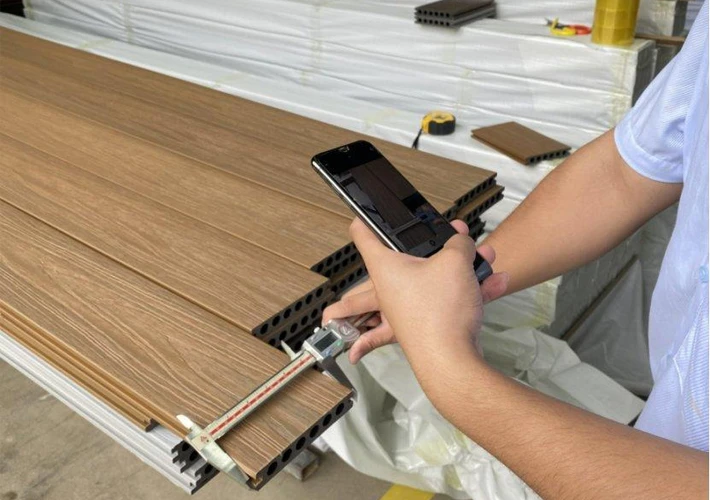
Confirm Manufacturing Capacity and Quality Control
For wholesalers and large project contractors, production capacity directly influences delivery reliability.
A professional ASA decking factory should have a clear manufacturing and inspection process.
A typical quality control process may include:
Incoming material inspection
Raw materials should be checked for consistency and compliance with production specifications.
Production process monitoring
Extrusion temperature, line speed, surface appearance, and product dimensions should be monitored.
Finished product inspection
Finished boards should be checked for length, width, thickness, surface defects, and color consistency.
Packaging inspection
Products should be packed to reduce the risk of scratches, deformation, and damage during transportation.
For large orders, buyers may also arrange third-party inspections before shipment.
Understand MOQ, Lead Time, and Container Loading
Commercial buyers need more than a competitive factory price.
They also need reliable order planning and logistics.
When requesting an ASA decking quotation, importers should confirm:
- Minimum order quantity (MOQ).
- Available board dimensions.
- Standard and customized colors.
- Production lead time.
- Sample availability.
- Packaging specifications.
- Container loading quantity.
- Shipping port.
- Warranty conditions.
For distributors, the ability to combine different colors or specifications in one order can be valuable, depending on the manufacturer’s production arrangements.
A detailed quotation should clearly distinguish product costs, packaging, optional accessories, and shipping-related expenses.
Why Work with Solidexwood as Your ASA Decking Supplier?
Solidexwood is a Chinese factory brand specializing in composite outdoor materials, including composite decking and exterior cladding solutions.
Our approach focuses on providing practical products and supply solutions for international B2B customers.
For importers, wholesalers, distributors, and project contractors, working directly with a factory can offer several advantages.
1. Direct Factory Supply
Working with a Chinese manufacturer provides direct communication about product specifications, customization requirements, production arrangements, and order planning.
2. Outdoor Product Development
Solidexwood focuses on developing composite outdoor products for different climate conditions and architectural applications.
Our ASA decking range is positioned as a premium outdoor solution for markets requiring improved weatherability and surface protection.
3. Customized Product Solutions
Depending on the selected product and order requirements, buyers can discuss:
- Customized colors.
- Different board dimensions.
- Surface textures.
- Installation accessories.
- Packaging requirements.
- Product development and specification adjustments.
4. Support for International B2B Orders
We understand that importers and distributors need reliable product information, clear quotations, sample support, and export arrangements.
Solidexwood works with overseas buyers to discuss product selection and bulk purchasing requirements.
5. Solutions for Different Outdoor Applications
Our composite outdoor products can be considered for swimming pool surroundings, garden terraces, commercial landscapes, residential decks, and exterior building projects.
For customers looking to expand their outdoor building material product lines, ASA decking can be a valuable addition to an existing WPC decking portfolio.
Installation and Maintenance Tips for Long-Lasting Poolside ASA Decking
Even high-quality ASA composite decking requires correct installation to achieve its expected performance.
For swimming pool projects, installation quality is particularly important because the decking is continuously exposed to water, sunlight, and temperature fluctuations.
Prepare a Stable Supporting Structure
Before installing ASA decking, contractors should prepare a stable and level supporting structure.
The substructure may use suitable aluminum, galvanized steel, or other compatible joist systems, depending on the project design and environmental conditions.
The supporting structure should:
- Provide sufficient load-bearing capacity.
- Maintain consistent joist spacing.
- Resist corrosion in the intended environment.
- Allow adequate water drainage.
- Provide sufficient ventilation underneath the decking.
For coastal swimming pools, corrosion-resistant fixing systems are particularly important.
Follow the Recommended Board Spacing
Composite decking expands and contracts with temperature changes.
If boards are installed too tightly, thermal expansion may cause deformation, buckling, or excessive pressure between adjacent boards.
Contractors should follow the manufacturer’s installation recommendations for:
- Side-to-side board gaps.
- End-to-end expansion gaps.
- Distance between joists.
- Distance from walls and fixed structures.
- Fixing clip and fastener positioning.
Installation spacing should take local temperatures and board dimensions into account.
Ensure Effective Drainage
Water should not accumulate underneath the decking.
A suitable installation should provide enough space for water to flow away from the deck structure.
For poolside installations, contractors should pay particular attention to:
- Ground slope.
- Drainage channels.
- Board spacing.
- Ventilation openings.
- Access for cleaning and inspection.
These details help reduce moisture accumulation and support long-term system performance.
Clean the Decking Regularly
Routine cleaning helps preserve the appearance of ASA decking.
For most ordinary dirt and dust, water and a suitable mild detergent are sufficient.
Avoid using aggressive solvents, highly concentrated chemicals, or abrasive cleaning tools unless they have been specifically approved by the manufacturer.
For commercial swimming pool facilities, establishing a regular cleaning schedule is recommended.
Inspect the Complete Decking System
Maintenance should not focus only on the board surface.
Contractors and facility managers should periodically inspect:
- Fixing clips and screws.
- Supporting joists.
- Expansion gaps.
- Drainage channels.
- Board ends.
- Areas exposed to heavy foot traffic.
Any damaged components should be repaired or replaced according to the manufacturer’s instructions.
Proper installation and routine maintenance can help maximize the service life of the complete decking system.
Conclusion: Why ASA Decking Is a Competitive Choice for Swimming Pool Projects
Choosing the right swimming pool decking material requires balancing durability, appearance, safety, maintenance, and overall project costs.
ASA composite decking offers several advantages for outdoor swimming pool environments. Its UV-resistant surface helps maintain color and appearance under sunlight exposure, while its composite structure provides a practical alternative to untreated natural timber.
Its main advantages include:
- Excellent UV resistance and improved color retention.
- Good outdoor weatherability.
- Potentially improved thermal comfort compared with conventional PE alternatives, depending on product specifications.
- Better moisture resistance than untreated natural timber.
- Low routine maintenance requirements.
- Attractive wood-like appearances and flexible design options.
- Durable surface protection for outdoor applications.
For hotel developers, swimming pool contractors, landscape designers, and building material distributors, these characteristics make ASA decking an interesting option for premium outdoor projects.
However, selecting the right product still requires checking wet-condition slip resistance, structural strength, drainage design, chemical compatibility, and relevant testing documentation.
Solidexwood, a professional composite decking supplier from China, provides ASA outdoor decking solutions for international importers, wholesalers, distributors, and project contractors.
Whether you are sourcing ASA decking for swimming pools, resort terraces, residential gardens, or commercial outdoor landscapes, our team can help you explore suitable specifications, colors, and bulk purchasing solutions.
Looking for a reliable ASA decking manufacturer in China?
Contact Solidexwood to request product specifications, samples, factory quotations, and customized solutions for your next outdoor decking project.
Frequently Asked Questions About ASA Decking for Swimming Pools
1. Is ASA decking suitable for swimming pools?
Yes. ASA composite decking can be used around outdoor swimming pools because it combines a weather-resistant ASA surface with a composite core. It offers good UV resistance, moisture resistance, and low routine maintenance requirements. However, buyers should verify wet-condition slip resistance and ensure the complete installation system is suitable for poolside use.
2. Is ASA decking waterproof?
ASA decking is designed for outdoor applications and generally offers good resistance to moisture. The ASA surface helps protect the board, while the composite core typically absorbs less water than untreated natural timber. However, the actual water absorption rate depends on the core formulation and board construction. It should not be assumed to be completely waterproof under every condition.
3. Does ASA decking become hot in direct sunlight?
Like other outdoor decking materials, ASA decking can become warm when exposed to direct sunlight. Surface temperature depends on the material formulation, color, weather, and installation conditions. Solidexwood’s ASA decking range focuses on improved outdoor thermal comfort compared with conventional PE alternatives. Buyers should request comparative surface-temperature test results when this is a key project requirement.
4. Is ASA decking slip-resistant when wet?
Slip resistance depends on the surface texture, board design, and material formulation. Textured ASA decking may be suitable for poolside applications, but grooves alone do not guarantee safety. Buyers should request wet-condition slip resistance test reports and confirm compliance with local swimming pool safety requirements.
5. How long does ASA composite decking last?
The service life depends on the ASA surface formulation, composite core quality, installation, climate, traffic, and maintenance. A properly manufactured and installed ASA decking system can provide long-term outdoor performance. Buyers should request product-specific durability testing and written warranty conditions rather than relying on a universal lifespan estimate.
6. Can ASA decking withstand chlorine from swimming pools?
ASA materials offer useful chemical resistance, but the complete decking product should be checked for compatibility with pool chemicals. Normal splashing from properly maintained pool water may be manageable, but concentrated chlorine, strong cleaning agents, and prolonged chemical exposure may damage certain products. Always follow the manufacturer’s chemical compatibility and cleaning recommendations.
7. Is ASA decking better than traditional WPC decking?
ASA decking generally offers an advantage in UV resistance and outdoor surface protection because of its ASA protective layer. Traditional WPC may offer a lower initial purchase price and can perform well in many outdoor applications. The better option depends on the project climate, performance requirements, budget, and expected maintenance costs.
8. Can ASA decking be used in tropical climates?
Yes. ASA composite decking is particularly interesting for tropical and subtropical outdoor projects because of its UV-resistant surface and weatherability. Buyers should still evaluate heat performance, drainage, dimensional stability, and installation requirements under local climate conditions.
9. What colors are available for ASA swimming pool decking?
Common options include teak, walnut, light oak, grey, and dark brown. Actual availability depends on the manufacturer’s product range. Solidexwood can discuss available colors and customization requirements for wholesale and project orders.
10. Can I purchase ASA decking directly from a Chinese factory?
Yes. Importers, wholesalers, distributors, and project contractors can purchase ASA composite decking directly from Chinese manufacturers. Direct factory sourcing can provide more flexibility in product specifications, colors, packaging, and bulk order arrangements.
Contact Solidexwood for product catalogs, technical specifications, samples, and wholesale quotations.