Introduction: Why Importers Choose Co-Extrusion WPC Decking from China
The global outdoor building materials market continues to create opportunities for importers, distributors, landscape contractors, and construction material wholesalers. As property developers and commercial project owners seek alternatives to traditional timber, wood plastic composite (WPC) decking has become an important product category for outdoor flooring applications.
Among the available composite decking options, co-extrusion WPC decking attracts particular attention because it combines a wood-plastic composite core with an additional protective polymer surface layer. This structure is designed to improve surface protection, weather resistance, stain resistance, and color retention compared with many conventional uncapped WPC products.
For B2B buyers, co-extrusion decking is not simply another outdoor flooring product. It can be a higher-value addition to an existing building materials portfolio, particularly for markets where customers prioritize appearance, reduced maintenance, and long-term outdoor performance.
China is an important sourcing destination for WPC decking because buyers can access a broad manufacturing supply chain, multiple product configurations, customization services, and export-oriented production facilities. However, not every Chinese supplier offers the same material formulation, production technology, quality control, or technical support.
Choosing the right China co-extrusion WPC decking manufacturer therefore requires more than comparing quotations.
Importers should evaluate the product structure, surface quality, dimensions, performance data, factory capability, packaging, production lead time, and total landed cost before committing to a bulk order.
As a China-based composite outdoor product brand, Solidexwood focuses on serving international B2B customers looking for composite decking and related outdoor material solutions. Our goal is to help distributors, wholesalers, contractors, and project buyers identify suitable products for their target markets and purchasing requirements.
This guide explains the essential considerations for sourcing co-extrusion WPC decking from China and building a sustainable supplier relationship.
What Is Co-Extrusion WPC Decking and How Does It Work?
Co-extrusion WPC decking is a wood plastic composite decking product manufactured by extruding a composite core and a protective outer layer together during production.
The core commonly contains wood fiber or wood flour, thermoplastic polymers, and functional additives. The outer layer is formulated to provide additional surface protection and the desired decorative appearance.
The exact formulation, polymer type, layer thickness, and degree of surface coverage vary by manufacturer and product model. Buyers should therefore request technical information for the specific decking profile they intend to purchase.
Understanding the Co-Extrusion Structure
A typical co-extrusion decking board consists of two principal components.
1. WPC core
The core provides the board’s main structural body. Its composition, density, profile design, and dimensions influence stiffness, strength, weight, and overall performance.
The quality of the core depends on several factors, including raw material selection, mixing consistency, extrusion temperature, processing conditions, and dimensional control.
2. Protective polymer cap
The outer layer is designed to protect the composite core from environmental exposure and everyday surface contamination. Depending on the product design, the cap may cover the top and sides or surround the profile more extensively.
This distinction is important for importers. A fully capped profile and a product with only selected surfaces covered should not automatically be treated as equivalent.
Ask the manufacturer for a cross-sectional sample or technical drawing showing exactly which surfaces are protected.
Co-Extrusion WPC vs. Traditional WPC Decking
Traditional uncapped WPC decking and co-extrusion WPC decking can both be suitable for outdoor use, but they offer different surface characteristics and price positions.
| Comparison factor | Traditional WPC decking | Co-extrusion WPC decking |
|---|---|---|
| Structure | Composite core with an exposed surface | Composite core with an additional polymer cap |
| Surface protection | Depends on formulation and surface treatment | Additional protection from the capped layer |
| Moisture exposure | Performance depends on the core formulation and installation | Cap can help reduce surface moisture penetration |
| Stain resistance | Varies by product | Often improved with an appropriately engineered cap |
| Color retention | Depends on pigments, additives, and exposure | Protective surface may improve color stability |
| Maintenance | Generally requires routine cleaning | Often easier to clean when the surface is properly designed |
| Initial purchasing cost | Often lower | Commonly higher |
| Market positioning | Value-oriented residential and commercial supply | Mid-range to premium outdoor applications |
These are general comparisons rather than guaranteed performance results. Actual product performance depends on material formulation, construction, manufacturing quality, installation, and environmental conditions.
Why Co-Extrusion Technology Matters to Distributors
For wholesalers and importers, co-extrusion technology can help create a differentiated product category.
Instead of competing exclusively on the lowest price per square meter, distributors can offer customers a product positioned around surface durability, appearance, cleaning convenience, and outdoor application requirements.
This may be particularly useful when supplying hotels, resorts, commercial terraces, landscape contractors, residential developers, and outdoor living retailers.
However, distributors should avoid relying on terms such as “second-generation decking” without checking the actual construction. Request a physical cross-section, product specifications, and relevant performance evidence to confirm what the supplier is offering.
Common Applications for Co-Extrusion WPC Decking
Co-extrusion WPC decking is commonly considered for:
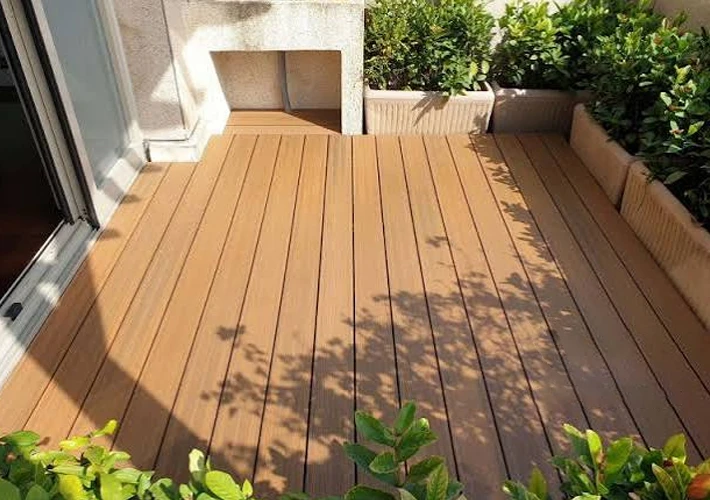
- Residential patios, gardens, and terraces.
- Hotel balconies and resort outdoor spaces.
- Restaurant terraces and outdoor dining areas.
- Swimming pool surroundings.
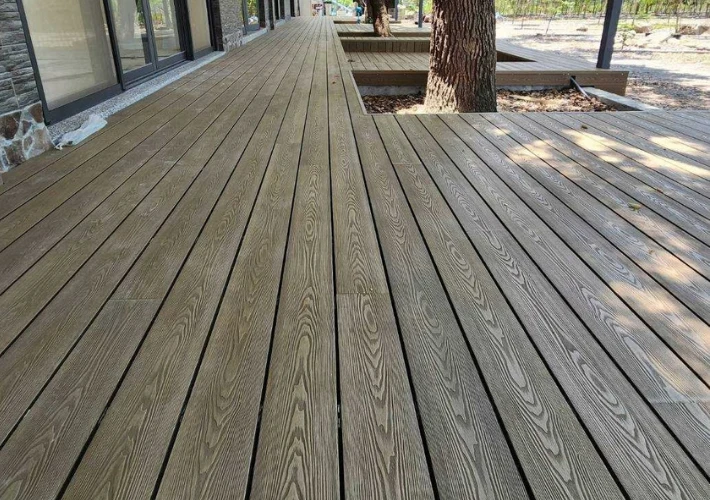
- Commercial walkways and landscaped areas.
- Rooftop terraces and leisure spaces.
- Villas, residential developments, and hospitality projects.
- Outdoor platforms and selected recreational areas.
For swimming pool areas, public walkways, elevated decks, or other demanding applications, buyers should confirm slip resistance, structural requirements, drainage, support spacing, and relevant local regulations before specifying the product.
A suitable decking board is only one part of a complete outdoor flooring system.
Key Benefits of Co-Extrusion WPC Decking for Wholesale Buyers
Understanding the commercial value of co-extrusion decking helps importers decide whether the product fits their target market and customer base.
Improved Surface Protection
The protective cap is one of the main differences between co-extrusion decking and many traditional composite boards.
When properly engineered and manufactured, this outer layer can help reduce surface staining, moisture exposure, and wear caused by normal outdoor use.
For distributors, this can provide a clear selling point when customers compare different composite decking options.
Nevertheless, a protective cap does not make every product immune to scratches, chemical damage, standing water, or surface deterioration. Buyers should evaluate the specific product and its recommended cleaning procedures.
Better Color Stability
Outdoor decking is exposed to sunlight, temperature changes, rain, and other environmental conditions. These factors can affect the appearance of composite materials over time.
A properly formulated co-extruded cap can improve resistance to UV-related color changes. Pigments, stabilizers, cap material, and production consistency all contribute to the result.
Importers serving Australia, the Middle East, Southern Europe, or other high-sunlight markets should pay particular attention to weathering data and color-retention claims.
Ask for available accelerated weathering test reports and clarify the test conditions. Accelerated laboratory results should not be interpreted as an exact prediction of years of service in every climate.
Reduced Routine Maintenance
Traditional timber decking may require periodic sealing, staining, or other surface treatments, depending on the wood species and environmental conditions.
WPC decking is generally selected as a lower-maintenance alternative. Co-extrusion can provide additional surface protection that makes routine cleaning more convenient.
For commercial properties, reduced maintenance requirements can be attractive because cleaning and repair activities may interrupt the use of outdoor spaces.
A practical maintenance program should still include removing dirt and leaves, cleaning spills promptly, checking drainage, and inspecting the fixing system.
Consistent Decorative Appearance
Co-extrusion WPC decking is available in various colors, textures, and profile designs, depending on the manufacturer’s range.
Common commercial preferences include:
- Light oak and natural wood-inspired colors.
- Grey and charcoal tones.
- Walnut-inspired brown finishes.
- Contemporary dark colors.
- Brushed or embossed wood-grain surfaces.
For importers, maintaining consistent product appearance across repeat orders is important. Customers who purchase additional boards for future projects may expect the same color and texture as the original installation.
Before placing a large order, approve a physical reference sample and establish the supplier’s color-matching procedure.
Suitable for Different Market Segments
Co-extrusion decking can support multiple commercial strategies.
A building materials wholesaler may sell standard colors and lengths through an established distribution network. A project contractor may require specific dimensions and accessories. A private-label distributor may need branded packaging, customized product information, and a consistent product range.
The key is to match the product specification with the requirements of the intended customer rather than selecting a profile based on appearance alone.
Potential Long-Term Commercial Value
A higher initial product cost does not necessarily mean a higher total cost of ownership.
Importers should consider the purchase price alongside installation requirements, maintenance, expected service conditions, replacement risk, and warranty coverage.
However, cost savings should be supported by realistic technical evidence rather than assumed from the co-extrusion label itself.
For B2B buyers, the most valuable product is the one that meets the required performance level while remaining commercially competitive in the target market.
How to Evaluate Co-Extrusion WPC Decking Specifications and Quality
Product specifications should be confirmed before requesting a final quotation. Small differences in profile dimensions, construction, material formulation, or accessories can significantly affect the cost and suitability of an order.
Dimensions and Profile Design
The first step is to establish the required board dimensions.
Important specifications include:
| Specification | What importers should confirm |
|---|---|
| Width | Finished width and manufacturing tolerance |
| Thickness | Nominal thickness and tolerance |
| Length | Standard lengths and customization options |
| Profile | Solid, hollow, or another specified design |
| Weight | Weight per board or per square meter |
| Surface | Embossed, brushed, or other specified finish |
| Cap coverage | Which surfaces are protected |
| Color | Standard color or approved custom color |
| Fixing system | Compatible clips, screws, and installation method |
| Accessories | Joists, edge trims, end caps, and related components |
Do not assume that products with similar external dimensions have identical structural performance.
Profile geometry, wall thickness, internal reinforcement, material composition, and support spacing can all influence the suitability of the board for a particular application.
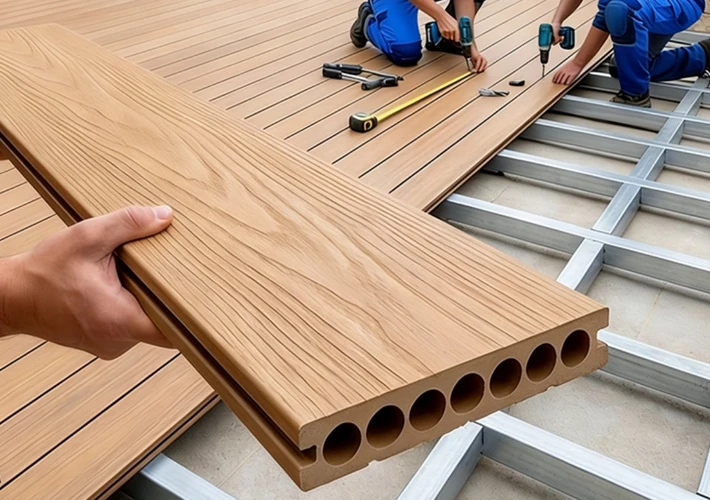
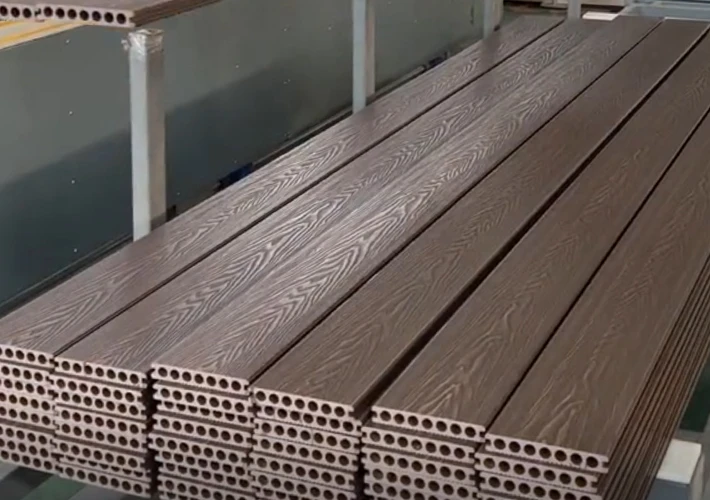
Solid vs. Hollow Co-Extrusion Decking
Both solid and hollow profiles are used in composite decking, and the appropriate choice depends on the intended application.
Solid profiles generally contain more material per unit length and may offer a substantial board construction. They can also be heavier and more expensive to transport.
Hollow profiles use internal cavities to reduce material consumption and board weight. They can be attractive for projects where weight and cost efficiency are important.
Neither option should be selected based on weight alone.
For commercial installations, evaluate the manufacturer’s load-related information, recommended joist spacing, fixing method, profile dimensions, and installation instructions.
The board, support structure, fasteners, and installation conditions must work together as a system.
Core Material and Cap Quality
The core formulation and protective layer both deserve attention.
Ask the manufacturer about the main material categories, raw material controls, extrusion process, and inspection procedures.
For the cap, review:
- Surface uniformity.
- Color consistency.
- Texture quality.
- Layer adhesion.
- Edge and corner appearance.
- Resistance to normal cleaning procedures.
- Available weathering and wear test data.
Layer adhesion is particularly important. If the cap separates from the core, the surface protection and appearance may deteriorate.
Where relevant, ask for test reports that evaluate cap-to-core bonding or peeling resistance.
Thermal Expansion and Installation Requirements
WPC decking expands and contracts with temperature changes. Installation guidance is therefore essential, especially for long boards and projects exposed to substantial temperature variations.
Importers should confirm:
- Recommended gaps between board ends.
- Required spacing between adjacent boards.
- Recommended joist spacing.
- Suitable fastening clips and screws.
- Ventilation and drainage requirements.
- Instructions for different installation temperatures.
- Special requirements for poolside or elevated installations.
Incorrect installation can cause movement, buckling, uneven surfaces, or other problems even when the decking material itself is acceptable.
Distributors should obtain the manufacturer’s installation manual before selling the product to contractors.
UV Resistance, Water Exposure, and Slip Resistance
These properties should be evaluated according to the intended application and destination market.
For UV resistance, request relevant weathering data and identify the exact product model covered by the report.
For moisture resistance, check the test method, test duration, sample preparation, and reported results. Do not compare values from different test methods as though they were directly interchangeable.
For slip resistance, especially around pools and commercial walkways, ask for test data relevant to the intended use. Surface texture alone does not establish a formal slip-resistance rating.
Buyers should also consider drainage, cleaning, algae accumulation, footwear, and local environmental conditions.
Certificates and Test Reports
Documentation requirements depend on the destination market, project specifications, and applicable regulations.
Importers may need product test reports, environmental documentation, management-system certificates, or other evidence depending on the order.
When reviewing documents, check:
- Whether the manufacturer and production site are correctly identified.
- Whether the document covers the exact product model.
- Whether the test method is appropriate for the application.
- Whether the document remains valid where validity dates apply.
- Whether the results meet the buyer’s specified requirements.
- Whether additional local approvals are necessary.
A management-system certificate does not automatically demonstrate that a particular decking model meets every performance requirement.
Likewise, a test report for one profile should not automatically be applied to every product in a manufacturer’s range.
For project procurement, documentation should be reviewed before production or shipment rather than requested only after the cargo arrives.
How to Choose a Reliable China Co-Extrusion WPC Decking Manufacturer
The factory you choose will influence product consistency, order flexibility, communication, lead time, and long-term profitability.
For importers building a distribution business, supplier evaluation should therefore include both manufacturing capability and commercial support.
Check Actual Manufacturing Capability
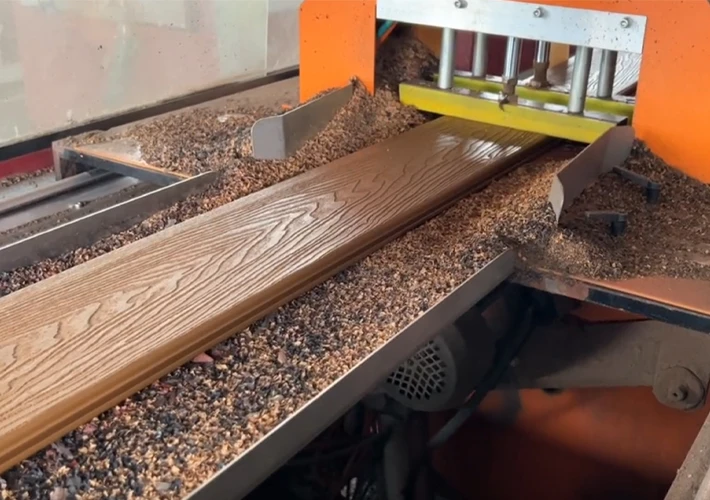
A supplier’s website and product catalog can provide an initial overview, but they do not replace factory verification.
Ask the manufacturer for information about:
- Factory location and production facilities.
- Co-extrusion production equipment.
- Available profile designs and molds.
- Production capacity and current workload.
- Raw material management.
- Quality inspection procedures.
- Packaging and warehouse arrangements.
- Export experience and shipment coordination.
Factory videos, live video inspections, samples, and third-party inspections can help buyers establish confidence before placing a large order.
Where possible, verify that the company supplying the quotation has a clear relationship with the actual production facility.
Evaluate OEM and ODM Services
OEM and ODM services can help distributors create a differentiated product offering.
Depending on the factory’s capabilities, customization may include:
- Private-label branding.
- Custom colors.
- Surface textures.
- Product dimensions.
- Packaging and carton printing.
- Product labels and barcodes.
- Installation manuals.
- Coordinated accessories.
- Customized product development.
Not every customization is available for every model. Buyers should confirm minimum order quantities, tooling costs, sample approval requirements, and production lead times before proceeding.
For a private-label program, the approved sample and written specification should become the reference for subsequent production.
Compare Samples Before Bulk Production
Samples provide a practical way to compare suppliers using consistent criteria.
Rather than evaluating only the color or surface appearance, importers should examine the board’s dimensions, weight, profile design, cap coverage, edge quality, texture, and overall finish.
Where the order is technically demanding, buyers may also commission independent testing.
A useful sample evaluation process is:
- Define the required product specification.
- Request samples from shortlisted manufacturers.
- Compare the samples against the same checklist.
- Review available technical documents.
- Confirm the intended application.
- Approve a reference sample in writing.
- Use the approved sample as a quality benchmark for production.
This process helps reduce misunderstandings and makes supplier comparisons more meaningful.
Assess Production Capacity and Lead Time
A supplier’s ability to produce an initial order does not automatically establish its ability to support recurring demand.
Ask about production scheduling, raw material availability, mold availability, customization requirements, and expected output during the proposed delivery period.
Lead time should be divided into relevant stages, including sample approval, production, inspection, packing, and shipment preparation.
For seasonal markets, plan orders early enough to accommodate manufacturing and international transport.
If a supplier provides an estimated lead time, clarify when the production period begins and what events could affect the delivery schedule.
Why Consider Solidexwood as Your Supply Partner?
Solidexwood is a China-based brand serving international buyers in the composite outdoor materials sector.
For importers and distributors, working with a manufacturing-focused supplier can simplify communication about product specifications, customization, production arrangements, and bulk purchasing.
Solidexwood aims to support B2B customers seeking composite decking solutions for distribution and project supply. Depending on the selected model and confirmed order requirements, buyers can discuss product selection, available finishes, packaging, and customized supply arrangements.
When evaluating Solidexwood or any other potential manufacturer, buyers should request the current product catalog, technical specifications, physical samples, quotation, and relevant quality documents for the exact product under consideration.
A long-term supplier relationship should be based on verified product quality, clear commercial terms, and consistent communication rather than brand claims alone.
Co-Extrusion WPC Decking Prices, MOQ, and Bulk Purchasing Costs
For international buyers, the price quoted by a Chinese manufacturer is only one part of the total procurement cost.
A meaningful comparison requires the same product specification, order quantity, packaging requirements, delivery terms, and destination assumptions.
What Influences the Factory Price?
Several factors affect the purchase price of co-extrusion WPC decking.
1. Raw materials
Polymer type, wood-based materials, pigments, stabilizers, and other additives influence the formulation and production cost.
2. Product dimensions
Wider or thicker boards and heavier profiles generally use more material per unit. Buyers should compare prices on a consistent basis, such as price per linear meter or price per square meter.
3. Co-extrusion construction
Cap material, cap coverage, layer thickness, and manufacturing complexity may affect production costs.
4. Profile design
Solid and hollow profiles differ in material usage, weight, and production requirements.
5. Surface finish and color
Embossed textures, specialized finishes, and customized colors can affect production costs and order flexibility.
6. Order quantity
Larger orders may improve production efficiency and reduce packaging or setup costs per unit. However, discounts depend on the factory’s actual cost structure and order conditions.
7. Customization
Private labeling, customized dimensions, special colors, and new molds may involve additional expenses.
Understanding MOQ Requirements
MOQ means minimum order quantity. It is determined by factors such as the product model, production setup, color requirements, packaging, and customization.
Standard products may have different MOQ requirements from products made with customized colors or special specifications.
Before requesting a formal quotation, tell the supplier:
- Your preferred decking model.
- Estimated quantity.
- Required colors.
- Standard or customized dimensions.
- Packaging requirements.
- Whether private labeling is needed.
- Destination country and port.
These details help the manufacturer provide a more relevant offer.
Do not assume that a supplier’s MOQ for one product applies to every profile or customized order.
Calculate the Total Landed Cost
Importers should estimate the full cost of getting the product to the intended warehouse or project location.
A practical cost structure includes:
| Cost component | What to consider |
|---|---|
| Product cost | Agreed factory price and quantity |
| Packaging | Standard or customized packaging |
| Accessories | Clips, screws, joists, and trims |
| Inspection | Internal or third-party inspection costs |
| Inland transport | Delivery to the loading port |
| Export charges | Applicable handling and documentation fees |
| Ocean freight | Route, shipping season, and cargo volume |
| Insurance | Coverage under the agreed shipping arrangement |
| Import duties and taxes | Requirements of the destination country |
| Port and customs charges | Local clearance and handling |
| Final delivery | Transport to warehouse or project site |
Not every quotation includes the same items. Buyers should confirm whether the price is EXW, FOB, CFR, CIF, or another agreed Incoterm, and identify the named place or port.
For example, an FOB quotation generally excludes the main ocean freight and destination import costs, while a CIF quotation includes cost, insurance, and freight to the named destination port. CIF does not mean that all destination charges, import duties, or final delivery costs are included.
Use the agreed Incoterms rules and the actual quotation to establish each party’s responsibilities.
Compare Price Per Square Meter Correctly
Decking prices are often quoted per board, per linear meter, or per square meter. These units are not interchangeable without calculation.
For a board with a nominal width of 140 mm and a length of 2.9 m, the nominal covered area is:
0.14 m × 2.9 m = 0.406 m² per board.
This calculation is only a starting point. Actual project coverage depends on the installed board width, the gap between boards, the layout, and cutting waste.
For project quotations, include the manufacturer’s installation recommendations and allow for appropriate cutting waste based on the layout.
A distributor comparing different manufacturers should also confirm whether quoted prices include accessories or only the decking boards.
Manage Inventory and Cash Flow
Large orders may improve unit pricing but also increase storage costs and working capital requirements.
For distributors, the purchasing strategy should reflect expected sales volume, warehouse capacity, seasonal demand, and the availability of repeat supply.
A practical approach is to start with a defined product range, test market demand, and expand the range based on customer feedback.
For private-label buyers, consider the additional time and inventory commitment associated with custom colors and packaging.
The best purchasing quantity is not necessarily the largest available order. It is the quantity that balances competitive cost, inventory turnover, supply reliability, and market demand.
Packaging, Shipping, and Quality Control for International Orders
WPC decking may travel through several stages of handling before reaching its destination. Packaging and shipping arrangements therefore deserve the same attention as the product itself.
Packaging Requirements
Ask the supplier how the boards will be bundled, protected, labeled, and prepared for container loading.
Depending on the product and destination, packaging may include protective film, protective end materials, straps, palletization, or other suitable arrangements.
For long-distance shipments, packaging should help prevent surface scratches, impact damage, contamination, and movement during transportation.
For private-label orders, confirm the artwork, labels, product codes, and package quantities before production.
The final packaging method should be appropriate for the product dimensions, transport conditions, and handling requirements.
Container Loading and Freight Planning
The number of boards that can be loaded into a container depends on their dimensions, packaging, stacking arrangement, and weight.
Importers should ask for a packing list or loading plan that includes:
- Quantity per bundle.
- Dimensions of each package.
- Total number of packages.
- Gross weight.
- Net weight.
- Estimated cargo volume.
- Accessories and additional components.
- Proposed loading arrangement.
Both volume and weight matter when planning container shipments.
A quotation that appears attractive at the factory level may become less competitive if the packaging uses cargo space inefficiently.
For large projects, buyers should coordinate the required decking boards and accessories to reduce the risk of incomplete deliveries.
Pre-Shipment Quality Inspection
A pre-shipment inspection can help verify whether the finished goods match the approved sample and purchase order.
The inspection plan should be agreed before production or shipment, particularly for large or customized orders.
Recommended inspection points include:
Dimensions: Check the board width, thickness, length, and relevant tolerances.
Appearance: Inspect color consistency, texture, scratches, surface defects, and edge quality.
Structure: Check the profile design and confirm that the delivered product matches the specified model.
Cap quality: Where applicable, inspect surface uniformity and look for peeling, bubbles, or visible separation.
Quantity: Verify the number of boards, bundles, accessories, and packages.
Packaging: Check labels, protective materials, bundle stability, and packing-list accuracy.
Documentation: Confirm that the invoice, packing list, and other agreed shipping documents are consistent.
For technically demanding projects, inspection can include specified measurements or laboratory tests. Buyers should establish acceptance criteria before the inspection takes place.
Installation and After-Sales Support
The manufacturer’s responsibilities do not end when the container is loaded.
Distributors benefit from having accurate installation instructions, maintenance guidance, product specifications, and technical support available for their customers.
Before shipment, request documentation covering the approved installation system, joist spacing, fastening method, expansion gaps, drainage, cleaning, and relevant application limitations.
If a problem occurs, clear records of the order, batch, approved sample, installation conditions, and inspection results can make investigation more efficient.
For repeat orders, document any agreed changes to the product, packaging, or installation system.
A structured process helps importers maintain consistent customer service and protect their reputation in the local market.
Frequently Asked Questions About Buying Co-Extrusion WPC Decking from China
Is co-extrusion WPC decking better than traditional WPC decking?
Co-extrusion WPC decking has an additional protective polymer layer designed to improve surface protection and, depending on the formulation, resistance to staining, moisture exposure, and UV-related color changes.
Traditional WPC decking can still be suitable for many applications and may offer a lower initial purchase price.
The better choice depends on the intended application, budget, environmental conditions, technical requirements, and verified product performance.
How long does co-extrusion WPC decking last?
Service life varies with product quality, installation, climate, exposure, maintenance, and usage.
Importers should request the manufacturer’s warranty terms, relevant test data, and installation requirements rather than relying on a universal lifespan claim.
A warranty period is not automatically the same as a guaranteed service life under every installation condition.
Is co-extrusion WPC decking suitable for high-UV regions?
It can be considered for high-UV regions, but suitability depends on the specific formulation, cap construction, pigments, and weathering performance.
Buyers serving Australia, the Middle East, or other high-sunlight markets should request relevant UV-weathering data and confirm the product’s intended environmental conditions.
Can importers customize colors and dimensions?
Customization depends on the manufacturer’s production capabilities, available molds, and order requirements.
Potential options include colors, surface finishes, lengths, branding, packaging, and selected profile dimensions.
Confirm MOQ, tooling requirements, sample approval, and lead time before ordering customized products.
What should buyers request before placing a bulk order?
At minimum, request the product catalog, technical specifications, physical samples, quotation, MOQ, production lead time, packaging details, and relevant test reports.
For customized or project-based orders, also confirm the approved sample, acceptance criteria, accessories, installation instructions, shipping terms, and documentation requirements.
How can importers compare Chinese WPC decking manufacturers fairly?
Compare suppliers using the same product specification, quantity, packaging requirements, and shipping terms.
Evaluate manufacturing capability, sample quality, technical documentation, communication, production scheduling, and after-sales support.
The lowest quotation should not automatically be considered the best offer. Product quality and supply reliability can have a substantial impact on the total cost of the business.
What information is needed for a WPC decking quotation?
To receive a useful quotation, provide the intended application, product dimensions, profile type, color, estimated quantity, customization requirements, destination country or port, and preferred shipping terms.
If you already have a reference sample, technical drawing, or project specification, share it with the manufacturer to improve quotation accuracy.
Why source co-extrusion WPC decking directly from a Chinese manufacturer?
Direct sourcing can provide more direct communication about specifications, production schedules, customization, and quality requirements.
It may also give buyers access to a wider range of product options and factory-level commercial discussions.
However, importers should still verify the actual production capability, product quality, and commercial terms of the selected supplier.
How can I start sourcing co-extrusion WPC decking from Solidexwood?
Start by identifying the products and specifications that suit your market. Contact Solidexwood to discuss available decking profiles, colors, dimensions, sample arrangements, customization options, and bulk-order requirements.
For the most accurate quotation, provide your estimated order quantity, destination market, packaging preferences, and any relevant technical requirements.
Conclusion: Partner with Solidexwood for Co-Extrusion WPC Decking Supply
Choosing a China co-extrusion WPC decking manufacturer is an important purchasing decision for importers, wholesalers, distributors, and project contractors.
The right supplier should offer more than a competitive factory price. Product construction, cap quality, dimensional consistency, weathering performance, production capability, packaging, and technical support all contribute to a successful sourcing decision.
Before placing a bulk order, confirm the product specification, evaluate physical samples, review relevant documentation, establish clear acceptance criteria, and calculate the total landed cost.
For distributors, a well-planned sourcing process can reduce purchasing uncertainty, improve product consistency, and support long-term market development.
Solidexwood welcomes inquiries from international distributors, wholesalers, importers, and project buyers seeking composite decking solutions from China.
Contact Us
Contact Solidexwood to request product information, discuss customization, compare suitable profiles, and explore supply options for your next outdoor decking project.
Solidexwood — Your Partner for Composite Outdoor Materials.