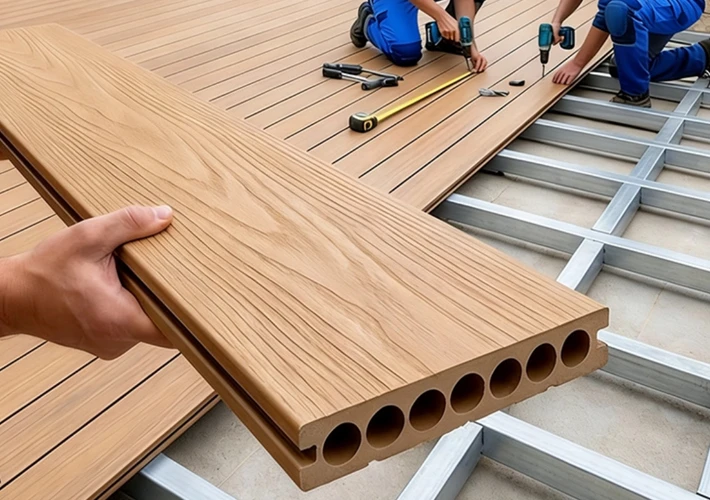
Composite decking has become an increasingly popular alternative to traditional timber decking for residential, commercial, hospitality, and outdoor landscaping projects. For importers, distributors, contractors, architects, and project developers, understanding what materials are used in composite decking is important when comparing suppliers, evaluating product quality, and selecting the right decking system for a specific market.
Unlike traditional wood decking, composite decking is engineered from a combination of different materials. The exact formulation varies between manufacturers, product generations, and performance requirements. Common ingredients include wood fiber or wood flour, polymers such as PE or PVC, mineral fillers, additives, pigments, and protective surface layers.
The ratio and quality of these materials directly affect important properties such as moisture resistance, dimensional stability, strength, surface appearance, color retention, slip resistance, and service life.
For B2B buyers, therefore, it is not enough to ask whether a product is simply called “WPC decking.” It is more useful to understand its material composition, manufacturing technology, surface treatment, and quality-control system.
At Solidexwood, we manufacture composite decking and exterior building products in China, with solutions designed for distributors, contractors, landscape projects, commercial developments, and outdoor applications. This article explains the major materials used in composite decking and what buyers should consider when evaluating different formulations.
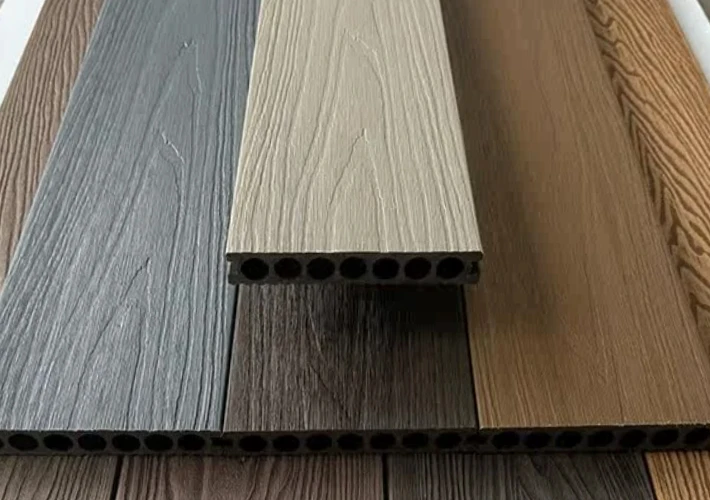
What Is Composite Decking Made Of?
Composite decking is generally made by combining a structural polymer matrix with a reinforcing material. In wood-plastic composite decking, the reinforcing material is usually wood-derived material, while the polymer provides binding, moisture resistance, and durability.
A simplified composite decking formulation can include:
| Material | Main Function |
|---|---|
| Wood fiber / wood flour | Natural appearance, stiffness, reinforcement |
| PE, PVC or other polymers | Binding, water resistance, durability |
| Mineral fillers | Stiffness, dimensional control, formulation adjustment |
| Coupling agents | Improve bonding between wood and polymer |
| Stabilizers | Improve resistance to heat, weather, and UV exposure |
| Pigments | Provide the desired color |
| Lubricants / processing aids | Improve extrusion and production consistency |
| Foaming agents | Used in some lightweight profiles |
| Protective surface layer | Improves stain, scratch, UV, and weather resistance |
Not every composite decking product contains all of these materials. The formulation depends on the manufacturing process and the intended application.
For example, a standard co-extruded decking board may use a composite core combined with a polymer-rich outer layer. A capped decking product is designed differently from a traditional uncapped WPC board. Similarly, lightweight decking may use a foamed structure to reduce weight and material consumption.
This is why buyers should evaluate the complete construction of the board, rather than making a purchasing decision based only on the term “composite.”
Wood-Plastic Composite Is One Major Category
WPC, or wood-plastic composite, is one of the most widely recognized forms of composite decking.
The basic principle is relatively simple:
Wood-based material + polymer + additives + processing technology = composite decking
However, the performance of the finished product depends heavily on the quality of these components and how they are processed.
Two boards can both be advertised as “WPC decking” while having significantly different formulations, densities, surface structures, and weathering performance.
For B2B buyers, asking a supplier for a technical data sheet, material composition range, profile structure, and applicable test reports can provide a much clearer basis for comparison.
Wood Fiber and Wood Flour
Wood is one of the most important materials in many composite decking products.
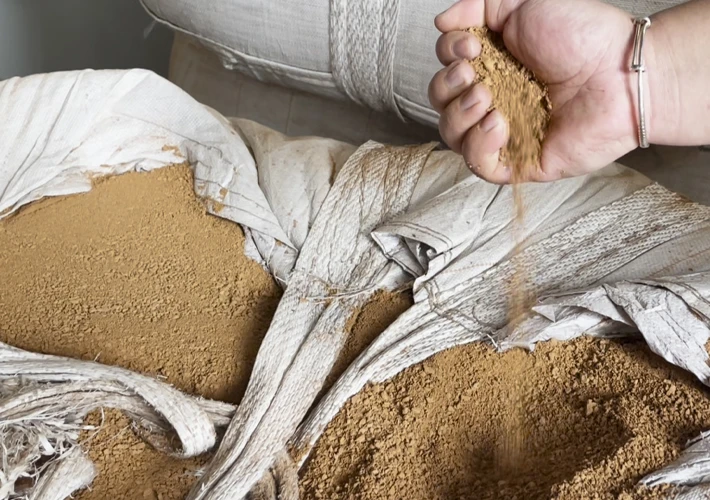
Manufacturers may use wood flour, wood fiber, sawdust, wood particles, or other processed wood materials depending on the production technology.
Wood flour is usually a finely processed wood material. Because of its small particle size, it can be blended relatively evenly with polymer materials during extrusion.
Wood fiber can provide reinforcement and contribute to the rigidity and natural appearance of the finished board.
Why Is Wood Used?
The addition of wood-derived material provides several functions.
First, it helps create a visual appearance that is closer to natural timber. This is particularly important for outdoor landscaping, gardens, poolside areas, terraces, balconies, resorts, restaurants, and hospitality projects.
Second, wood-based material can contribute to stiffness and structural characteristics.
Third, using processed wood material can help manufacturers develop a range of textures and surface appearances.
However, wood is also hygroscopic, meaning it naturally interacts with moisture. Therefore, controlling the relationship between wood content and polymer content is important when designing a decking formulation.
Does More Wood Mean Better Decking?
Not necessarily.
This is an important point for buyers.
A higher wood content does not automatically mean higher quality. Increasing wood content can change the board’s density, stiffness, moisture behavior, appearance, and processing characteristics.
The more important question is whether the formulation is properly engineered for the intended environment.
For example, a decking board intended for a humid climate may require a formulation and surface design focused on moisture resistance and dimensional stability. A product for high-temperature or high-UV markets may require additional stabilization and surface protection.
Therefore, rather than asking a supplier simply, “How much wood is in the board?” buyers should also ask about:
- Polymer type
- Wood material type
- Wood-to-polymer ratio
- Density
- Water absorption
- Dimensional stability
- UV resistance
- Surface treatment
- Mechanical properties
- Recommended installation conditions
These specifications provide a more complete picture of product quality.
Polyethylene and Other Polymer Materials
The second major component of many composite decking products is the polymer.
Several types of polymers can be used, but polyethylene (PE) is particularly common in wood-plastic composite decking.
Other polymer systems, including PVC and polypropylene, can also be used in composite outdoor products.
The polymer acts as the matrix that binds the wood particles or fibers together.
Polyethylene Composite Decking
PE-based composite decking is widely used because polyethylene provides useful properties for outdoor applications.
Depending on the grade and formulation, PE can contribute to:
- Moisture resistance
- Chemical resistance
- Flexibility
- Impact performance
- Processing efficiency
- Outdoor durability
Recycled PE may also be used in certain composite decking formulations. However, the source and consistency of recycled polymer are important.
A manufacturer with effective material control should be able to maintain consistent production even when recycled materials are incorporated into the formulation.
PVC-Based Composite Products
PVC can also be used in certain composite decking systems.
PVC has different physical and processing characteristics from PE. PVC-based formulations can offer good dimensional stability and weathering performance when properly engineered.
However, buyers should avoid comparing PE and PVC simply by asking which one is “better.” The appropriate polymer depends on the product structure, application, processing method, and performance requirements.
Why Polymer Quality Matters
The polymer is not simply a filler. It plays a central role in the performance of the finished decking board.
Poor-quality or inconsistent polymer material can influence:
- Board strength
- Surface quality
- Processing stability
- Impact resistance
- Weathering behavior
- Dimensional stability
- Long-term consistency
For this reason, professional composite decking manufacturers typically control incoming polymer materials as part of their quality-control process.
Mineral Fillers and Functional Additives
Wood and polymer are the primary materials, but modern composite decking formulations often contain smaller quantities of other materials.
These can include mineral fillers, stabilizers, pigments, lubricants, coupling agents, antioxidants, and UV stabilizers.
These materials may represent a relatively small percentage of the overall formulation, but they can have a significant effect on processing and product performance.
Mineral Fillers
Some composite products use mineral fillers such as calcium carbonate.
Mineral fillers can be used to adjust:
- Stiffness
- Density
- Dimensional stability
- Processing characteristics
- Cost structure
The amount and particle size need to be properly controlled. Excessive filler content does not automatically produce a better product.
Coupling Agents
Wood and polymer have different chemical characteristics. A coupling agent can help improve the interaction between these two components.
This is important because a composite material needs to behave as a relatively integrated structure rather than as separate wood particles surrounded by plastic.
Good interfacial bonding can contribute to better mechanical properties and more consistent product performance.
UV Stabilizers
Outdoor decking is continuously exposed to sunlight.
UV radiation can influence polymer materials and pigments over time, potentially causing color changes and surface degradation.
UV stabilizers and other weathering additives can therefore be incorporated into the formulation to improve resistance to outdoor exposure.
The exact performance still depends on the complete formulation, surface structure, climate, exposure conditions, and maintenance.
Pigments
Pigments provide the base color of composite decking.
Common colors include:
- Brown
- Dark brown
- Grey
- Light grey
- Walnut
- Teak
- Black
- Red-brown
Modern manufacturing technology allows suppliers to produce wood-inspired colors that imitate different timber species.
For commercial projects, consistent color production is especially important because buyers may need to reorder the same product months or years later.
What Is Used on the Surface of Composite Decking?
The core material is only part of modern composite decking technology.
Many higher-performance decking systems use a protective outer layer, often called a cap, coating, or co-extruded surface layer.
This surface layer is designed to provide additional protection against the outdoor environment.
Co-Extruded Composite Decking
In co-extruded decking, the core and outer layer are produced together during the manufacturing process.
The core generally provides the main structural function, while the outer layer can improve surface performance.
Depending on the formulation, the protective layer can provide enhanced resistance to:
- Staining
- Moisture
- UV exposure
- Scratching
- Fading
- Everyday outdoor contamination
The exact performance varies by product.
Why Does the Surface Layer Matter?
Consider a commercial deck installed outside a restaurant.
The deck may be exposed to:
- Food and beverage spills
- Rain
- Foot traffic
- Dirt
- Sunlight
- Cleaning chemicals
- Temperature changes
In such situations, the surface is particularly important.
A well-designed surface layer can make cleaning easier and help maintain the appearance of the deck over time.
For B2B projects, buyers should therefore distinguish between:
Uncapped WPC decking
and
Capped or co-extruded composite decking.
The two products can have different performance characteristics and price levels.
How the Materials Affect Composite Decking Performance
Understanding the materials becomes much more useful when connected to actual product performance.
Different materials and formulations influence different characteristics of a decking board.
Moisture Resistance
Polymer content and surface protection play an important role in reducing moisture-related problems.
Unlike untreated natural timber, properly engineered composite decking does not depend on a conventional wood-preservation treatment system.
However, this does not mean every composite decking board is completely unaffected by water.
Water absorption, drainage, installation gaps, board design, and core formulation still matter.
Dimensional Stability
Composite decking expands and contracts as temperatures change.
The polymer system, wood content, density, profile structure, and installation method can all influence dimensional movement.
For this reason, professional installation should follow the manufacturer’s recommended expansion gaps and fixing requirements.
Strength and Stiffness
Wood fiber, polymer content, mineral fillers, board density, and profile geometry all contribute to mechanical performance.
A hollow decking profile, for example, uses internal geometry to reduce weight while maintaining an appropriate level of rigidity.
Solid boards may offer a different combination of weight, strength, and impact resistance.
Color Retention
Color retention depends on pigments, polymer formulation, UV stabilizers, surface protection, and exposure conditions.
A decking board installed in a high-UV environment such as Australia, Southeast Asia, the Middle East, or other sunny markets may require different weathering considerations than one installed in a lower-UV environment.
Slip Resistance
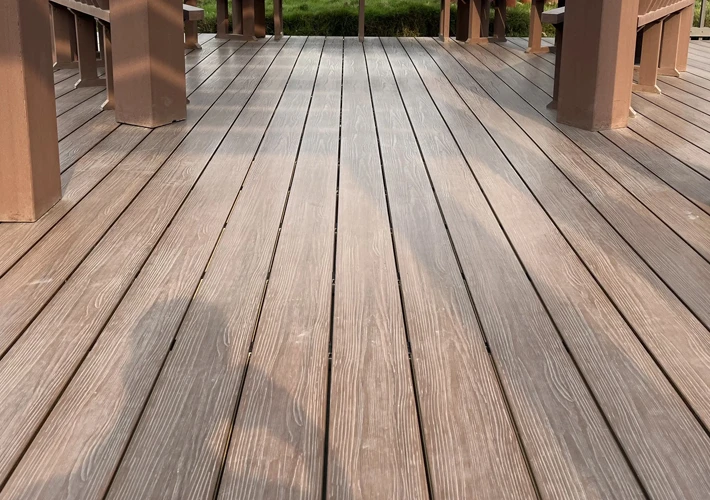
Slip resistance is influenced by surface texture and profile design.
Common surface finishes include:
- Wood grain
- Embossed grain
- Brushed texture
- Deep grooves
- Fine grooves
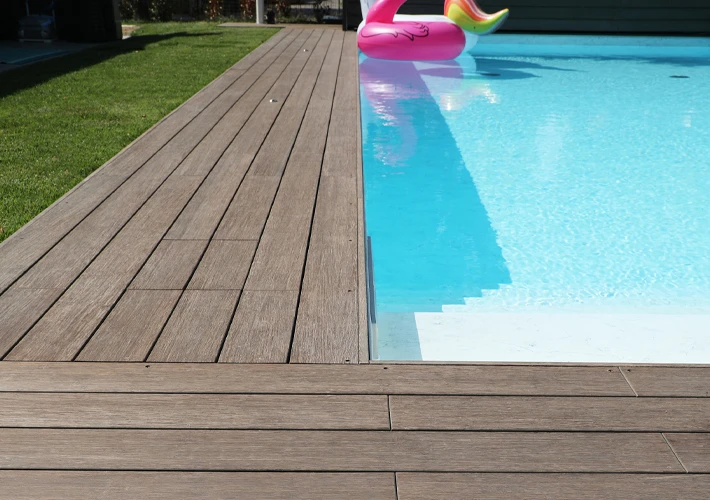
For poolside, hospitality, public landscaping, and commercial projects, buyers should request appropriate slip-resistance information rather than judging performance by appearance alone.
Solid vs Hollow Composite Decking: Does Material Composition Change?
Another important consideration for B2B buyers is the internal structure of the decking board.
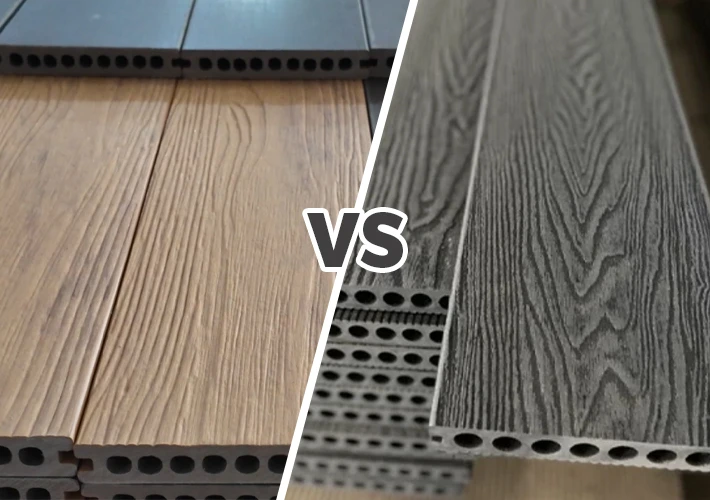
Composite decking is commonly available in solid, hollow, and semi-hollow profiles.
Solid Composite Decking
Solid boards contain more material throughout their cross-section.
Potential characteristics include:
- Higher weight
- Strong profile
- Good impact resistance
- Substantial appearance
- Suitable for demanding applications
However, higher material consumption can increase transportation and product costs.
Hollow Composite Decking
Hollow boards contain internal cavities.
This can reduce:
- Product weight
- Material consumption
- Transportation weight
Hollow decking can be an attractive option for projects where weight and cost management are important.
However, the internal profile must be properly engineered.
Profile Design Matters
Material composition alone does not determine the performance of a decking board.
Two products with similar raw materials can perform differently because of differences in:
- Board thickness
- Internal rib structure
- Density
- Extrusion technology
- Surface treatment
- Fixing system
This is why professional buyers should evaluate both material formulation and profile engineering.
How to Choose Composite Decking from a China Factory
For importers and distributors, selecting the right composite decking supplier involves more than comparing the price per square meter.
A professional sourcing process should consider the material, manufacturing process, quality control, customization capability, packaging, and export experience.
1. Ask About the Core Formulation
Ask the manufacturer what the main components are.
For WPC decking, this commonly includes:
Wood material + polymer + additives + pigments/fillers
The supplier should be able to explain the general material structure clearly.
2. Confirm the Polymer Type
Ask whether the product uses PE, PVC, PP, or another polymer system.
If recycled polymer is used, ask about the manufacturer’s material-control process and consistency.
3. Check the Surface Structure
Determine whether the decking is:
- Uncapped
- Co-extruded
- Capped
- Painted or coated
- Embossed
- Brushed
The surface technology can have a major impact on the final price and performance.
4. Request Technical Data
For commercial projects, useful information may include:
- Board dimensions
- Weight per meter
- Density
- Water absorption
- Flexural strength
- Impact resistance
- Thermal expansion
- Slip resistance
- UV/weathering performance
- Recommended installation method
The exact test methods and standards should also be confirmed when required by the target market.
5. Evaluate Factory Capability
A reliable China composite decking manufacturer should have control over the complete production process.
Important areas include:
- Raw material inspection
- Mixing
- Extrusion
- Cooling
- Embossing
- Surface treatment
- Cutting
- Packaging
- Final inspection
For large B2B orders, production consistency can be just as important as the specification of the first sample.
6. Consider OEM and Customization
Importers and distributors may require:
- Custom colors
- Custom dimensions
- Private-label packaging
- Embossed textures
- Different profile structures
- Customized accessories
- Matching fencing or cladding products
Working directly with a China factory can make these requirements easier to coordinate.
7. Consider the Complete System
Composite decking is rarely used as a board alone.
A complete decking system may include:
- Decking boards
- Joists
- Clips
- Screws
- Starting clips
- End clips
- Fascia boards
- Corner profiles
- Finishing accessories
A supplier capable of providing a complete system can simplify procurement for distributors and contractors.
Conclusion
The main materials used in composite decking are generally wood-derived materials and polymer materials, supported by various functional additives, pigments, fillers, and, in some products, protective surface layers.
Wood fiber or wood flour contributes to the natural appearance and structural characteristics of WPC decking, while polymers such as PE or PVC provide the binding matrix and help create moisture-resistant outdoor products. Additional materials such as mineral fillers, coupling agents, UV stabilizers, pigments, lubricants, and antioxidants can be used to fine-tune processing and performance.
Modern composite decking can also incorporate a protective co-extruded or capped surface layer. This technology is particularly relevant for commercial and outdoor applications where resistance to staining, moisture, UV exposure, and everyday wear is important.
For B2B buyers, however, material composition should not be evaluated in isolation. Board density, profile design, manufacturing technology, surface structure, additives, quality control, and installation requirements all contribute to the final performance of composite decking.
At Solidexwood, we focus on composite outdoor products for distributors, importers, contractors, architects, and project buyers. Our product development combines material selection, extrusion technology, profile engineering, surface design, and quality control to provide composite decking solutions for different outdoor applications and markets.
If you are sourcing composite decking from China, the most useful questions are not simply “What is it made of?” but also what polymer is used, what type of wood material is incorporated, how is the core engineered, what surface technology is applied, what tests have been completed, and how consistently can the factory reproduce the product?
These questions can help buyers make a more informed comparison between composite decking suppliers and select a specification appropriate for their market and project requirements.
Solidexwood — Composite Decking & Outdoor Building Materials from China.
For OEM/ODM projects, wholesale orders, custom colors and profiles, or complete outdoor composite solutions, contact the Solidexwood team for product specifications and factory support.