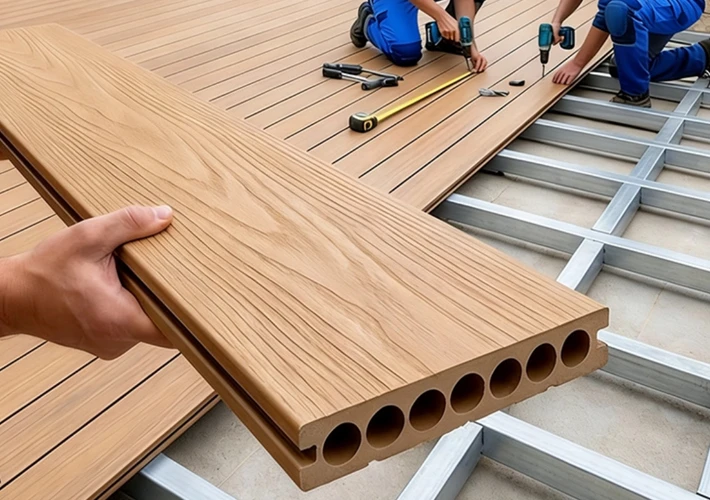
Choosing the right outdoor decking material is an important decision for homeowners, architects, contractors, developers, distributors, and building material importers. Outdoor flooring is exposed to sunlight, rain, humidity, temperature changes, foot traffic, stains, and other environmental conditions for years. Therefore, the material used for a deck must offer more than an attractive appearance. It also needs to provide reliable durability, weather resistance, color stability, moisture resistance, and easy maintenance.
Traditional WPC decking has become a popular alternative to natural wood because it offers a wood-like appearance with lower maintenance requirements. However, as outdoor applications have become more demanding, decking technology has continued to evolve.
ASA decking is one of the newer developments in this market. Often described as a third-generation outdoor composite decking solution, ASA decking combines a structural composite core with an ASA weather-resistant surface layer. This technology is designed to improve UV resistance, color stability, surface protection, and long-term outdoor performance.
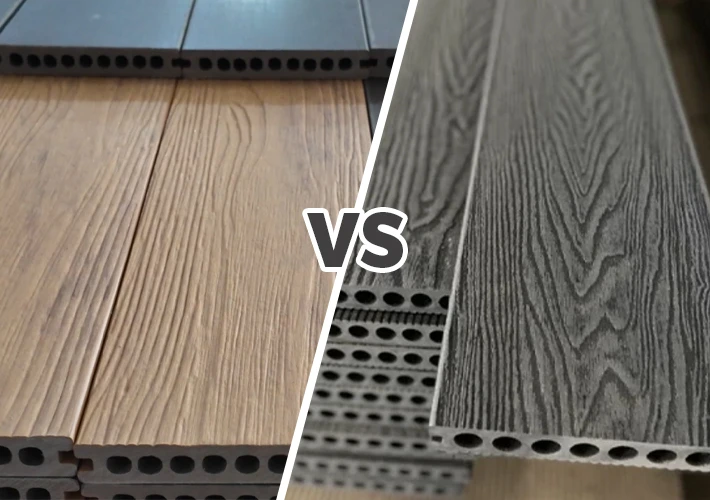
So, when comparing ASA decking vs traditional WPC decking, which is better?
The answer depends on the application, climate, budget, and performance requirements. Traditional WPC can still be a practical choice for cost-sensitive projects, while ASA decking is particularly attractive for premium residential, hospitality, commercial, poolside, and high-UV outdoor applications.
For buyers looking for higher weather resistance and long-term appearance retention, ASA decking can provide significant advantages.
Solidexwood is a China-based manufacturer specializing in outdoor composite decking and advanced ASA decking solutions for international distributors, wholesalers, contractors, and project buyers. In this guide, we compare ASA decking and traditional WPC decking from material structure, UV resistance, durability, maintenance, applications, cost, and long-term value.
What Is Traditional WPC Decking?
WPC stands for Wood Plastic Composite. Traditional WPC decking is generally manufactured by combining wood fibers or wood flour with thermoplastic materials and various additives. The mixture is processed and extruded into decking boards with different profiles, colors, textures, and surface finishes.
The basic idea behind WPC decking is simple: combine some of the visual characteristics of wood with the moisture resistance and processing advantages of polymers.
Compared with natural timber, WPC decking can reduce several common problems associated with traditional wood decking, including:
- Rotting
- Termite damage
- Frequent painting
- Regular staining
- Moisture-related deterioration
- Splitting and cracking
- High maintenance requirements
This is one of the main reasons WPC decking has become widely used in residential gardens, balconies, patios, terraces, walkways, resorts, and commercial outdoor areas.
However, not all WPC decking products are the same.
Traditional WPC decking can vary significantly depending on the polymer type, wood content, additives, pigments, extrusion technology, surface treatment, and manufacturing quality.
Some traditional WPC products have an exposed composite surface. Others use additional protective technologies, such as co-extruded polymer caps.
An uncapped WPC board exposes its composite material directly to the outdoor environment. A co-extruded board adds another protective layer to improve surface performance.
These developments have helped improve WPC decking, but they also created a new question for buyers: if a protective outer layer is important, what material should be used for that layer?
This is where ASA decking becomes particularly interesting.
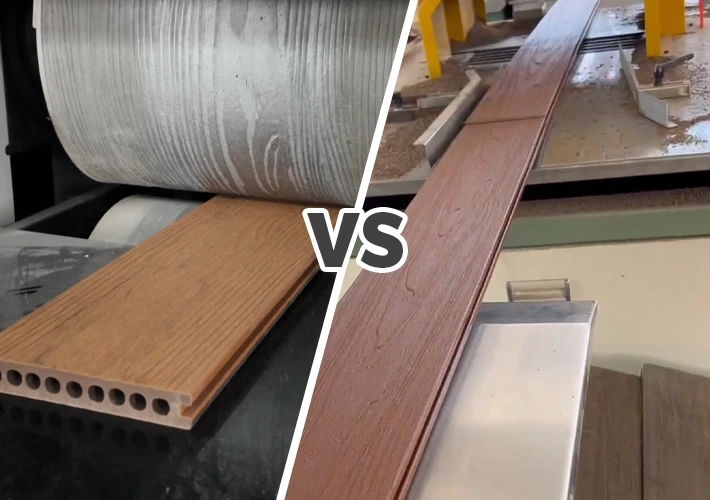
What Is ASA Decking and Why Is It Called Third-Generation Outdoor Flooring?
ASA decking is an advanced type of composite outdoor flooring that uses ASA, or Acrylonitrile Styrene Acrylate, as a high-performance protective surface.
ASA is an engineering thermoplastic recognized for outdoor weatherability, UV stability, and resistance to environmental exposure. In composite decking, the ASA surface works together with the structural core to create a decking board designed for demanding outdoor applications.
A simplified structure of ASA decking can be understood as:
ASA weather-resistant surface layer + structural composite core
The core provides the main structural characteristics of the board, while the ASA outer layer provides enhanced protection against sunlight, weathering, moisture, staining, and surface aging.
Solidexwood positions its ASA decking as a third-generation outdoor decking solution, reflecting the development of composite decking technology from traditional WPC to more advanced protected surfaces.
The evolution can be broadly understood in three stages.
First Generation: Traditional WPC Decking
The first generation of composite decking mainly focused on replacing natural wood with a wood-plastic composite material.
Its major advantages included:
- Lower maintenance than wood
- Better moisture resistance than untreated timber
- Reduced termite concerns
- Wood-like appearance
- Competitive cost
However, depending on the formulation and manufacturing process, traditional WPC products could experience surface fading, staining, weathering, and other appearance-related issues after long-term outdoor exposure.
Second Generation: Co-Extruded WPC Decking
The next development was co-extrusion.
Instead of exposing the composite core directly to the environment, manufacturers added a protective polymer layer around the surface.
This helped improve:
- Stain resistance
- Moisture protection
- Surface durability
- Weather resistance
- Color retention
Co-extrusion represented a major improvement over basic WPC decking.
Third Generation: ASA Decking
ASA decking takes the protective surface concept further by using ASA as the weather-resistant outer layer.
The objective is not simply to make the decking more attractive. It is to improve performance under long-term outdoor exposure.
The main advantages associated with ASA decking include:
- Enhanced UV resistance
- Better color stability
- Strong weatherability
- Improved surface protection
- Better resistance to outdoor aging
- Moisture resistance
- Low maintenance
- Premium appearance
Solidexwood’s ASA decking is designed specifically for customers looking for a higher-performance alternative to conventional outdoor composite flooring.
This makes ASA decking particularly relevant for markets where strong sunlight, humidity, rain, and high outdoor exposure are major concerns.
ASA Decking vs Traditional WPC Decking: Key Differences
Although ASA decking and traditional WPC decking can look similar, their surface technologies and performance positioning are different.
The most important difference is the protective surface.
Traditional WPC decking relies primarily on its composite formulation and, depending on the product, may have no additional protective layer.
ASA decking combines a structural core with an ASA protective surface designed specifically for demanding outdoor environments.
| Feature | Traditional WPC Decking | ASA Decking |
|---|---|---|
| Basic structure | Wood-plastic composite | Engineered composite core + ASA surface |
| Surface technology | Composite surface or basic treatment | ASA weather-resistant surface |
| UV resistance | Moderate to good, depending on formulation | Enhanced |
| Color stability | Depends strongly on formulation | High potential for color stability |
| Weather resistance | Good | Excellent potential |
| Moisture resistance | Good | Enhanced surface protection |
| Surface protection | Standard | Advanced |
| Maintenance | Low | Low |
| Outdoor appearance | Wood-like | Premium wood-like and architectural finishes |
| Hot-climate suitability | Depends on product | Particularly suitable for high-UV applications |
| Premium positioning | Mid-range | Premium |
| Initial cost | Generally lower | Generally higher |
| Long-term appearance | May change with exposure | Better designed for appearance retention |
It is important to understand that these are general material comparisons.
A high-quality traditional WPC product can outperform a low-quality ASA product. Manufacturing quality, formulation, ASA layer thickness, pigments, core composition, installation, drainage, ventilation, and local climate all affect actual performance.
Therefore, buyers should not evaluate decking based only on the word “ASA.”
The better approach is to examine the complete product structure and technical specifications.
Nevertheless, the ASA surface provides a significant technological advantage because it is specifically designed for outdoor weatherability.
For distributors and project buyers, this can create a clear product differentiation between standard WPC and premium ASA decking.
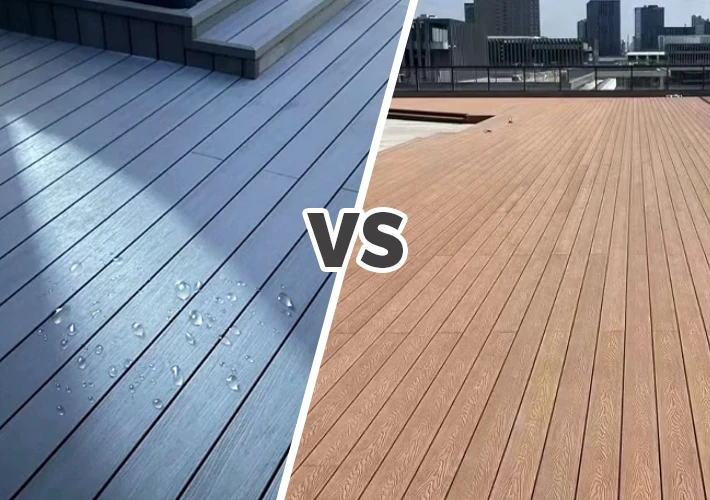
Why Does ASA Decking Have Advantages in Outdoor Environments?
Outdoor flooring has to deal with much more aggressive conditions than indoor flooring.
A deck may experience direct UV radiation, rain, humidity, temperature fluctuations, dust, dirt, spills, and continuous foot traffic.
Over time, these factors can affect both appearance and performance.
ASA decking was developed to address some of these challenges.
1. Enhanced UV Resistance
UV exposure is one of the biggest challenges for outdoor decking.
Long-term sunlight can cause materials to experience:
- Color fading
- Surface aging
- Chalking
- Loss of visual uniformity
- Polymer degradation
Traditional WPC decking can offer reasonable UV resistance, but its performance depends heavily on the formulation, pigments, stabilizers, and manufacturing technology.
ASA is known for its strong resistance to weathering and UV-related degradation. The ASA surface forms a protective barrier between the outdoor environment and the underlying composite structure.
This makes ASA decking particularly attractive for locations with intense sunlight.
Potential target markets include:
- Australia
- Southeast Asia
- Middle East
- South America
- Southern Europe
- Tropical regions
- High-altitude areas with strong sunlight
Solidexwood has positioned ASA decking as a solution for demanding outdoor environments where UV performance and long-term appearance are important purchasing considerations.
2. Better Color Stability
For many outdoor projects, color retention is nearly as important as structural durability.
Imagine a hotel installing premium brown decking around a swimming pool. If the surface fades unevenly after prolonged sun exposure, the overall appearance of the project can deteriorate even if the boards remain structurally functional.
This is especially important for:
- Hotels
- Resorts
- Restaurants
- Villas
- Luxury residences
- Commercial terraces
- Landscape projects
ASA technology is designed to improve color stability during outdoor exposure.
The ASA surface helps protect pigments and the underlying structure from environmental degradation.
However, it is important to be realistic: no outdoor decking material can remain completely unchanged forever under continuous sunlight.
Actual color performance depends on:
- Pigment quality
- ASA formulation
- ASA layer thickness
- UV stabilizers
- Production technology
- Local climate
- Installation conditions
- Sun exposure intensity
This is why professional buyers should request product samples and technical information before making a large order.
3. Stronger Weather Resistance
Outdoor decking must handle more than sunlight.
Rain, humidity, temperature changes, snow, wind, and pollution can all affect the material.
Traditional WPC already provides better outdoor moisture performance than many natural wood products, but advanced surface technology can further improve protection.
The ASA surface acts as an additional protective barrier against environmental exposure.
This is particularly useful in regions with:
- High humidity
- Heavy rainfall
- Strong sunlight
- Coastal weather
- Frequent temperature changes
- Long outdoor exposure
For international distributors, this creates an important selling point.
Instead of competing only on price, a distributor can position ASA decking as a higher-value outdoor product designed for more demanding applications.
4. Better Surface Protection
Outdoor decks are not only exposed to weather.
They are also exposed to people.
Furniture, shoes, pets, outdoor equipment, food, drinks, dust, and everyday traffic can all affect the surface.
A high-performance ASA surface can provide improved protection against common outdoor surface stresses.
This can be especially valuable in commercial environments where the appearance of the decking directly affects the appearance of the property.
For a private garden, minor surface changes may not be a major concern.
For a five-star hotel, resort, or commercial property, maintaining a consistent premium appearance can have much greater financial value.
5. Low Maintenance
Both traditional WPC and ASA decking have a major advantage over natural timber: relatively low maintenance.
Traditional wood decking may require:
- Sanding
- Staining
- Sealing
- Painting
- Regular surface treatment
Composite decking reduces many of these requirements.
ASA decking follows the same low-maintenance concept while adding a more weather-resistant surface.
Normal cleaning can generally involve removing dirt, leaves, dust, and other outdoor contaminants according to the manufacturer’s recommendations.
For commercial projects, low maintenance can reduce long-term labor and maintenance costs.
This is one reason composite decking has become increasingly attractive to property developers and facility managers.
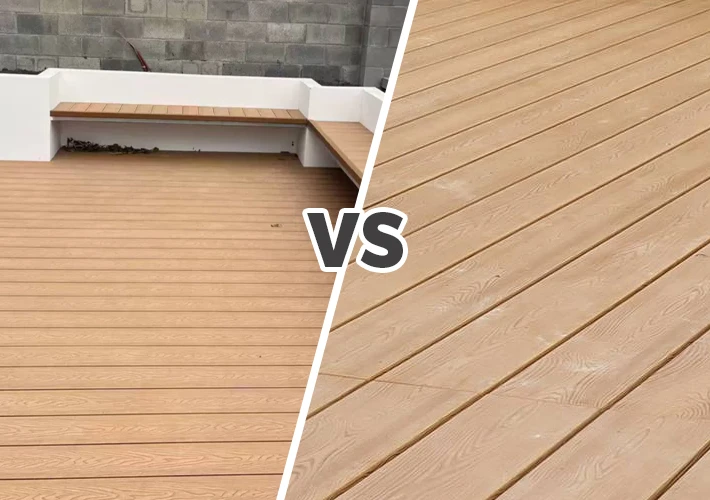
Which Is Better for Different Applications?
There is no universal answer to the question “Is ASA decking better than WPC decking?”
The better material depends on the application.
Residential Gardens
Traditional WPC can be a good solution for homeowners who want a wood-like appearance at a competitive price.
If the deck is partially shaded or the project has moderate environmental exposure, traditional WPC may provide sufficient performance.
ASA decking becomes more attractive when the homeowner wants:
- Premium appearance
- Better long-term color stability
- Stronger weather resistance
- Low maintenance
- Higher-end outdoor design
For luxury villas and high-end residential developments, ASA decking can provide a stronger premium positioning.
Poolside Decking
Poolside applications are among the most demanding outdoor flooring environments.
Decking around a swimming pool may be exposed to:
- Direct sunlight
- Water
- High humidity
- Frequent foot traffic
- Cleaning chemicals
- Chlorinated water splashes
ASA decking can be a strong option for these environments because its weather-resistant surface is designed to handle demanding outdoor exposure.
Solidexwood has specifically positioned its ASA decking for outdoor environments such as poolside areas where UV exposure and moisture are important considerations.
For any specific pool project, buyers should still check the manufacturer’s technical specifications, slip-resistance requirements, installation instructions, and local building regulations before selection.
Hotels and Resorts
Hotels and resorts are ideal applications for premium decking.
The material must not only perform well but also maintain a high-quality appearance.
Common applications include:
- Pool decks
- Resort terraces
- Outdoor restaurants
- Garden walkways
- Balcony flooring
- Villa platforms
- Leisure areas
For these projects, ASA decking can provide a stronger value proposition than entry-level WPC.
Commercial Terraces
Commercial terraces experience more frequent traffic than many residential decks.
Restaurants, cafes, shopping centers, office buildings, and commercial properties can benefit from low-maintenance outdoor flooring.
ASA decking can be positioned as a premium solution where surface durability, appearance retention, and weather resistance are important.
Coastal Projects
Coastal environments can be challenging because of humidity, moisture, sunlight, and salt-laden air.
ASA decking may be suitable for many coastal outdoor applications because of its weather-resistant surface.
However, coastal projects should always consider the entire installation system, including fasteners, joists, drainage, ventilation, and structural design.
The decking board is only one part of the complete outdoor flooring system.
Hot and Sunny Climates
Hot climates are another major opportunity for ASA decking.
Markets such as Australia, the Middle East, Southeast Asia, and parts of South America can experience intense sunlight and high temperatures.
Traditional WPC can still be used successfully in many hot-climate applications, but product specifications matter.
For projects where UV exposure is particularly strong, ASA decking provides an attractive premium alternative because its surface technology is designed around enhanced outdoor weatherability.
This is one of the strongest reasons for distributors to add ASA decking to their product portfolios.
Is ASA Decking Worth the Higher Price?
One of the most common questions from importers and distributors is whether ASA decking is worth the additional cost.
Traditional WPC usually has a lower initial purchase price.
ASA decking is generally positioned as a premium product and may cost more because of its advanced surface technology, material formulation, and manufacturing process.
However, purchasing decisions should not be based only on the initial price per square meter.
A better comparison is total value over the expected service period.
Consider a commercial project where inexpensive decking begins to experience noticeable fading after several years.
The property owner may eventually face:
- Cleaning costs
- Surface treatment
- Replacement
- Labor
- Appearance-related complaints
- Reduced project aesthetics
A premium decking product with stronger weatherability may reduce some of these long-term concerns.
For this reason, ASA decking can be particularly valuable when:
- The project has strong UV exposure.
- Appearance retention is important.
- The customer expects premium quality.
- Maintenance costs need to be minimized.
- The project is commercial or hospitality-based.
- The decking is used around a pool or resort.
- The distributor wants to offer a differentiated premium product.
On the other hand, traditional WPC may still be the better option when the main purchasing factor is low initial cost.
For example, a basic residential garden with limited sunlight exposure may not require premium ASA technology.
Therefore, the right strategy is not necessarily to replace all WPC products with ASA decking.
For distributors, a better strategy can be to offer both.
Traditional WPC can target value-conscious customers, while ASA decking can target premium projects.
This allows distributors to cover more market segments without competing solely on price.
How Should Importers and Distributors Choose ASA Decking?
For B2B buyers, choosing an ASA decking supplier requires more than comparing quotations.
The product itself is important, but so are manufacturing capabilities, quality control, customization, packaging, delivery, and export experience.
Before placing a bulk order, buyers should evaluate the following factors.
Check the Core Structure
Ask what material is used in the decking core.
The core affects:
- Strength
- Weight
- Dimensional stability
- Screw-holding performance
- Thermal behavior
- Overall durability
Solidexwood’s ASA decking product line uses an engineered composite structure designed to work together with the ASA surface layer.
Check the ASA Surface
Not every product marketed as “ASA decking” necessarily has the same surface structure.
Buyers should ask about:
- ASA layer technology
- Surface thickness
- Co-extrusion process
- Pigment system
- UV stabilization
- Weathering performance
- Surface texture
These specifications can make a major difference between products.
Request Samples
A sample is one of the most useful tools for B2B buyers.
Importers should compare samples for:
- Color
- Texture
- Surface quality
- Profile
- Weight
- Dimensional consistency
- Scratch resistance
- Visual appearance
If possible, samples should also be exposed to local outdoor conditions before a large commercial order.
Evaluate Factory Capability
A reliable supplier should be able to provide consistent production rather than simply source products from different factories.
For distributors, factory capability can influence:
- Product consistency
- Lead time
- MOQ
- Packaging
- OEM/ODM options
- Custom colors
- Custom profiles
- Quality control
- Export documentation
Solidexwood supplies outdoor decking solutions directly from China for international B2B customers, including distributors, wholesalers, contractors, and project buyers.
Consider the Target Market
Different countries have different preferences.
Some markets focus heavily on price.
Others prioritize:
- UV resistance
- Color stability
- Premium appearance
- Environmental performance
- Low maintenance
- Long-term durability
For example, a distributor serving a high-UV market may have a stronger reason to promote ASA decking than a distributor serving a mild climate.
Understanding the local market is therefore essential.
Frequently Asked Questions About ASA Decking vs Traditional WPC Decking
Is ASA decking better than traditional WPC decking?
ASA decking can provide advantages in UV resistance, color stability, weatherability, and surface protection compared with many conventional WPC decking products. However, the actual performance depends on the complete product formulation, manufacturing quality, installation, and environmental conditions.
Traditional WPC may still be a better choice for budget-sensitive projects where standard outdoor performance is sufficient.
What makes ASA decking different from WPC decking?
The biggest difference is the surface technology.
Traditional WPC decking is primarily based on a wood-plastic composite structure. ASA decking uses an engineered composite core together with an ASA weather-resistant surface layer.
The ASA layer is designed to improve resistance to UV exposure, weathering, moisture, staining, and surface aging.
Is ASA decking waterproof?
ASA decking provides strong moisture resistance, but buyers should distinguish between surface water resistance and the overall waterproof performance of an installed decking system.
Proper installation, drainage, ventilation, board spacing, substructure design, and local climate all affect outdoor performance.
Does ASA decking fade in sunlight?
ASA decking is designed for improved UV resistance and color stability.
However, no outdoor material should be considered completely immune to color change. Actual performance depends on the ASA formulation, pigments, layer thickness, exposure intensity, climate, and manufacturing quality.
The advantage of ASA is that it is specifically engineered for improved outdoor weatherability.
Is ASA decking suitable for hot climates?
Yes. ASA decking can be particularly attractive for hot and sunny climates because UV resistance and weatherability are important advantages of ASA surface technology.
However, buyers should also consider thermal expansion, installation spacing, ventilation, substructure design, and the manufacturer’s installation requirements.
Can ASA decking be used around swimming pools?
ASA decking can be suitable for poolside applications because of its outdoor weatherability and moisture-resistant surface.
For a specific swimming pool project, buyers should also verify slip resistance, local safety requirements, cleaning compatibility, and installation specifications.
Is ASA decking more expensive than traditional WPC?
Generally, ASA decking is positioned as a premium product and may have a higher initial cost than conventional WPC decking.
The additional investment may be justified when UV resistance, appearance retention, weatherability, and long-term value are important.
What is third-generation decking?
Third-generation decking is a market term used to describe newer composite decking technologies that provide more advanced surface protection and outdoor performance.
Solidexwood uses the term “third-generation outdoor decking” for its ASA decking because the product combines an engineered structural core with an advanced ASA weather-resistant surface.
Can ASA decking replace traditional WPC completely?
Not necessarily.
Traditional WPC remains useful for many applications, particularly where initial price is the primary consideration.
ASA decking is better viewed as a premium alternative for customers who need enhanced outdoor performance.
For distributors, carrying both traditional WPC and ASA decking can provide a broader product portfolio.
Why should I buy ASA decking from a Chinese manufacturer?
China has a mature building-material manufacturing industry and extensive experience in composite extrusion, co-extrusion, polymer processing, packaging, and international export.
Working directly with a Chinese factory can give importers access to:
- Factory pricing
- OEM/ODM services
- Customized profiles
- Custom colors
- Bulk production
- Export packaging
- Container loading
- Technical support
- Flexible project solutions
However, buyers should always evaluate the supplier’s factory capability, samples, technical specifications, quality-control procedures, and export experience before placing an order.
Conclusion: ASA Decking or Traditional WPC Decking?
So, ASA decking vs traditional WPC decking: which is better?
There is no single answer for every project.
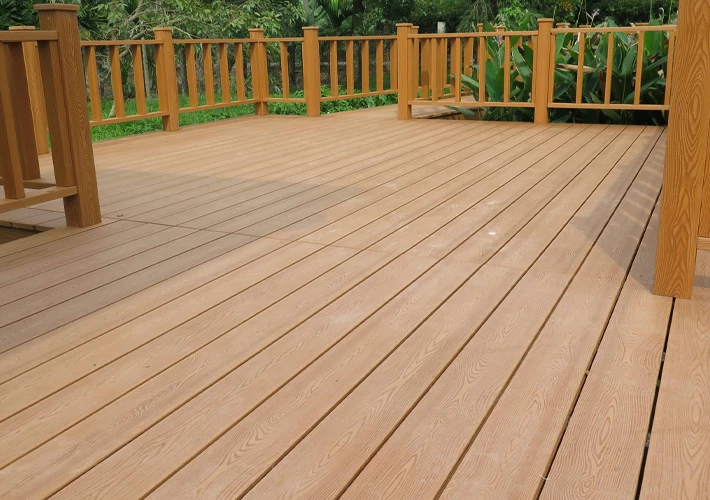
Traditional WPC decking remains a practical solution for customers looking for affordable outdoor flooring with a wood-like appearance, moisture resistance, and relatively low maintenance.
It is particularly suitable for standard residential and commercial applications where the environmental exposure is moderate and initial budget is an important consideration.
ASA decking, on the other hand, represents a more advanced generation of outdoor composite flooring.
Its biggest advantages include:
- Enhanced UV resistance
- Better potential for long-term color stability
- Strong weatherability
- Improved surface protection
- Moisture resistance
- Low maintenance
- Premium appearance
- Strong suitability for demanding outdoor environments
These characteristics make ASA decking particularly attractive for luxury residences, hotels, resorts, poolside areas, commercial terraces, coastal projects, landscaping projects, and high-UV markets.
For B2B buyers, the most important point is that ASA decking should not simply be viewed as a more expensive version of WPC.
It represents a different product positioning.
Traditional WPC focuses on cost-effective outdoor performance, while ASA decking focuses more strongly on premium surface protection, weatherability, UV resistance, and long-term appearance.
For distributors, wholesalers, and project buyers, this difference creates an opportunity to serve different market segments.
If your customers are highly price-sensitive, traditional WPC may remain the right choice.
If your customers are looking for premium outdoor flooring that can better handle strong sunlight and demanding weather conditions, ASA decking can provide a stronger value proposition.
Why Choose Solidexwood ASA Decking?
Solidexwood is a China-based manufacturer focused on composite outdoor building materials and advanced decking solutions.
Our ASA decking is developed as a third-generation outdoor flooring solution, combining an engineered structural core with an ASA weather-resistant surface.
For international distributors, wholesalers, contractors, landscape companies, developers, and project buyers, Solidexwood can provide factory-direct supply and customized solutions for different markets.
We understand that B2B customers need more than a product. They need stable quality, competitive pricing, reliable production, export packaging, technical support, and long-term supplier cooperation.
Whether you are looking for a premium ASA decking product for a hotel project, poolside application, villa development, commercial terrace, or distribution business, Solidexwood can help you evaluate the appropriate specifications and develop a solution for your market.
Looking for an ASA decking manufacturer in China? Contact Solidexwood for product samples, specifications, OEM/ODM options, wholesale pricing, and project support.