
Fire safety has become one of the most critical decision-making factors in modern architecture and façade design. Over the past decade, several high-profile building fires around the world have forced governments, developers, and designers to reassess how exterior wall materials are selected—especially composite cladding systems.
Today, fire-rated composite cladding is no longer just a “value-added option.” In many regions, it is a mandatory requirement. However, for many buyers, importers, and even specifiers, fire ratings such as A2, B1, or B-s1,d0 remain confusing and are often misunderstood or incorrectly compared.
This article provides a clear, in-depth, and professional explanation of the most commonly referenced fire-rated composite cladding standards. We will explain what these ratings mean, how they differ, where they apply, and how to choose the correct fire rating for your project—especially in international trade and large-scale construction.
Understanding Fire Rating Systems for Composite Cladding
Before comparing A2, B1, and B-s1,d0 directly, it is essential to understand how fire rating systems work and why different standards exist in different regions.
Why Fire Ratings Exist
Fire ratings are designed to evaluate how materials behave in a fire scenario, including:
- Ignitability – How easily the material catches fire
- Flame spread – How fast fire travels across the surface
- Heat release – How much energy is released during combustion
- Smoke production – Visibility and toxicity risks
- Burning droplets – Whether flaming debris spreads fire
For composite cladding, these factors are especially important because façade systems can act as vertical fire spread channels, accelerating fire from lower to higher floors.
Main Global Fire Rating Systems
There are two primary fire classification systems commonly referenced in composite cladding trade:
1.European Standard (EN 13501-1)
Used in:
- European Union
- United Kingdom
- Middle East (UAE, Saudi Arabia, Qatar)
- Southeast Asia (Singapore, Malaysia)
2.Chinese Fire Rating System (GB Standards)
Used in:
- Mainland China
- Some Belt and Road countries
- Export documents from Chinese factories
Understanding how these systems relate—and how they differ—is key to avoiding costly specification errors.
A2 Fire Rating: Near-Non-Combustible Composite Cladding
What Is A2 Fire Rated Cladding?
Under EN 13501-1, A2 is one of the highest fire performance classifications available for construction materials. A2-rated materials are considered almost non-combustible, with extremely limited contribution to fire.
Typical classification format:
A2-s1,d0
This includes:
- A2 – Reaction to fire
- s1 – Smoke production
- d0 – No flaming droplets
Fire Performance Characteristics of A2 Cladding
A2-rated composite cladding demonstrates:
- Extremely low heat release
- No flashover contribution
- Minimal flame spread
- Very limited smoke generation
- No burning droplets
In real fire scenarios, A2 cladding does not fuel the fire and primarily acts as a passive barrier.
Common Materials Used in A2 Composite Cladding
Achieving A2 performance typically requires high mineral content and strict formulation control. Common structures include:
- Mineral-filled composite cores (≥90% inorganic content)
- Fiber cement-based cladding
- Aluminum composite panels with mineral cores
- Magnesium oxide (MgO) composite systems
Pure polymer-based composites rarely reach A2 without significant mineral reinforcement.
Typical Applications of A2 Cladding
A2-rated composite cladding is often required for:
- High-rise residential buildings
- Hospitals and healthcare facilities
- Schools and universities
- Airports and transportation hubs
- Government and public buildings
In many EU countries, A2 is the default minimum requirement for façades above certain heights.
Cost and Trade Considerations
A2-rated cladding:
- Has higher raw material costs
- Requires more advanced production control
- Involves stricter third-party testing
However, it also:
- Reduces approval risks
- Speeds up compliance with fire authorities
- Increases project acceptance in regulated markets
For international buyers, A2 certification significantly improves market access.
B1 Fire Rating: The Chinese Fire Resistance Standard Explained
What Does B1 Mean in Fire Rating?
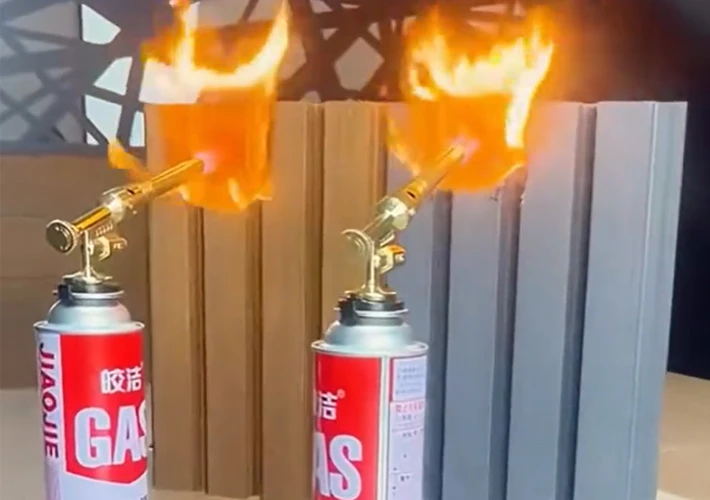
B1 is a fire classification under China’s GB 8624 standard. It is commonly described as “hardly combustible” material.
This rating is widely used in:
- Chinese domestic construction
- Export documentation from Chinese manufacturers
- Some developing markets that reference GB standards
Fire Performance of B1 Composite Cladding
B1-rated materials:
- Are difficult to ignite
- Burn slowly once ignited
- Self-extinguish under controlled conditions
- Produce moderate smoke levels
However, B1 materials are still combustible and will contribute some heat during a fire.
Key Differences Between B1 and European Ratings
One of the most common mistakes in international trade is assuming:
B1 ≈ A2 or B-s1,d0
This is incorrect.
- B1 does not equal A2
- B1 does not guarantee smoke or droplet performance
- B1 testing methods differ significantly from EN standards
While B1 indicates improved fire resistance compared to ordinary materials, it does not meet the same fire safety thresholds as European A2 or B-s1,d0 classifications.
When Is B1 Acceptable?
B1-rated composite cladding is typically acceptable for:
- Low-rise buildings
- Interior wall cladding
- Temporary structures
- Markets where GB standards are legally accepted
For export to Europe, the UK, or the Middle East, B1 alone is usually insufficien
B-s1,d0 Explained: The Most Common European Fire Classification
Breaking Down B-s1,d0
Under EN 13501-1, B-s1,d0 is one of the most widely used fire ratings for composite cladding.
It consists of three parts:
- B – Limited contribution to fire
- s1 – Very low smoke production
- d0 – No flaming droplets
This combination provides a balanced fire safety profile suitable for many commercial and residential projects.
Fire Behavior of B-s1,d0 Composite Cladding
Materials classified as B-s1,d0:
- Resist ignition under moderate fire exposure
- Slow flame spread significantly
- Produce very little smoke
- Do not create burning droplets that spread fire
In real-world fires, B-s1,d0 cladding buys valuable evacuation time and reduces secondary fire risks.
Typical Materials Achieving B-s1,d0
Common composite structures include:
- WPC with fire-retardant formulations
- PVC composite cladding with additives
- Aluminum composite panels with FR cores
- Polymer-mineral hybrid systems
These materials balance cost, performance, and compliance, making B-s1,d0 a popular choice in international projects.
Where B-s1,d0 Is Commonly Required
B-s1,d0 is frequently specified for:
- Mid-rise residential buildings
- Commercial façades
- Hotels and serviced apartments
- Retail and office buildings
- Renovation and retrofit projects
In many markets, B-s1,d0 is considered the minimum acceptable fire rating for exterior composite cladding.
Key Differences Between A2, B1, and B-s1,d0
Understanding the differences between these fire ratings is critical for correct specification and compliance.
Combustibility Comparison
- A2: Almost non-combustible
- B-s1,d0: Limited combustibility
- B1: Hardly combustible but still fuels fire
Smoke and Droplet Control
- A2-s1,d0: Minimal smoke, no droplets
- B-s1,d0: Very low smoke, no droplets
- B1: Smoke and droplets not strictly controlled
International Acceptance
- A2: Widely accepted globally
- B-s1,d0: Accepted across Europe, UK, Middle East
- B1: Mostly limited to China and select markets
Cost and Manufacturing Complexity
- A2: Highest cost, strict formulation
- B-s1,d0: Medium cost, flexible design
- B1: Lower cost, limited export acceptance
Risk Perspective
From a fire safety and liability standpoint:
- A2 offers maximum risk reduction
- B-s1,d0 offers balanced safety
- B1 carries higher approval and insurance risks
How to Choose the Right Fire Rated Composite Cladding for Your Project
Selecting the correct fire rating is not just a technical decision—it is a strategic and commercial one.
Step 1: Understand Local Regulations
Always verify:
- Local building codes
- Façade fire requirements
- Height-related regulations
- Use-type restrictions (residential vs commercial)
Never assume that a rating accepted in one country will be accepted in another.
Step 2: Identify Project Risk Level
Consider:
- Building height
- Occupancy density
- Evacuation complexity
- Insurance requirements
Higher-risk buildings justify higher fire ratings.
Step 3: Balance Cost and Compliance
While A2-rated composite cladding is more expensive, it may:
- Reduce approval delays
- Avoid redesign costs
- Improve long-term liability protection
In many projects, B-s1,d0 offers the best cost-performance ratio.
Step 4: Verify Test Reports Carefully
Always request:
- Official EN 13501-1 test reports
- Full test scope (substrate + system)
- Testing laboratory accreditation
- Product consistency documentation
Fire ratings are system-based, not just material-based.
Step 5: Work With Experienced Manufacturers
Factories with export experience understand:
- Certification requirements
- Market-specific standards
- Stable fire-retardant formulations
- Quality control consistency
This is especially important for large-volume or long-term supply contracts.
Conclusion: Fire Ratings Are Not Labels—They Are Risk Management Tools
Fire-rated composite cladding standards such as A2, B1, and B-s1,d0 are not interchangeable labels. Each represents a different level of fire performance, regulatory acceptance, and project risk.
- A2 offers the highest level of fire safety and global acceptance
- B-s1,d0 provides an excellent balance of safety and cost
- B1 remains limited to specific markets and applications
For developers, architects, and B2B buyers, choosing the correct fire rating is not only about passing inspections—it is about protecting lives, assets, and long-term project value.
As fire regulations continue to tighten worldwide, understanding and correctly applying these standards will become even more critical for the future of composite cladding systems.